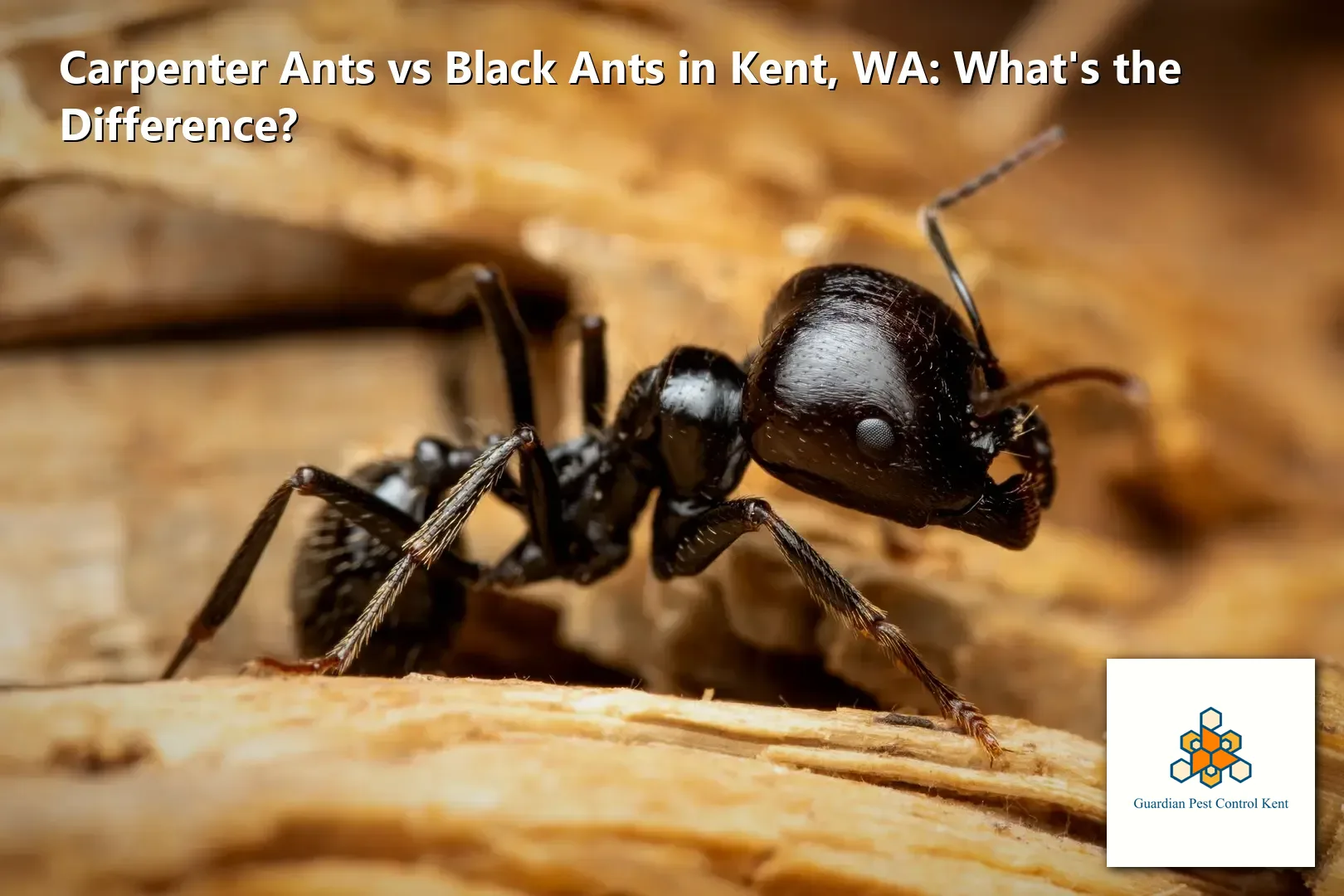
Key Takeaways
- Size is the primary identification feature: carpenter ants measure 1/4–1/2 inch; odorous house ants measure 1/16–1/8 inch.
- Odorous house ants emit a rotten coconut smell when crushed - a definitive identification test.
- Carpenter ants have a single smooth-curved thorax segment; odorous house ants have a notched thorax visible under magnification.
- Carpenter ants found indoors indicate moisture-damaged wood in the building structure.
- Carpenter ant frass (coarse sawdust mixed with insect debris) in a corner or under a baseboard is a diagnostic finding requiring immediate professional inspection.
- Treating odorous house ants with the same method used for carpenter ants (and vice versa) is ineffective - each species requires a different primary treatment approach.
- Both species require WSDA-licensed professional treatment once established inside a Kent, WA home.
Side-by-Side Comparison
| Feature | Carpenter Ant (C. modoc) | Odorous House Ant (T. sessile) |
|---|---|---|
| Size | 1/4–1/2 inch (6–13 mm) | 1/16–1/8 inch (1.5–3 mm) |
| Colour | Solid black; some red and black (C. vicinus) | Dark brown to black |
| Smell when crushed | None | Strong rotten coconut odour |
| Thorax shape (side view) | Single evenly-curved arc - no bumps | Uneven, slightly notched profile |
| Waist nodes | One node (petiole) visible with magnification | One node, difficult to see due to overlapping gaster |
| Winged reproductives? | Yes - large black swarmers (April–June) | Yes - small swarmers (spring) |
| Nest location (outdoor) | Dead tree stumps, logs, moist structural wood | Soil under stones, mulch, slab expansion joints |
| Nest location (indoor) | Moist or decayed wood - floor joists, studs | Wall voids, insulation, kitchen cabinet bases |
| Colony size | 2,000–10,000 workers (mature parent colony) | 10,000–100,000 workers (multi-queen) |
| Structural risk | High - excavates wood galleries | None - foraging and nesting pest only |
| Primary food | Insects, honeydew, protein | Sugars, carbohydrates, honeydew |
| Trail behaviour | Single file trails; most active at night | Dense trails; active throughout day |
How to Identify Each Species in the Field
Identifying Carpenter Ants
Size test: If the ant is larger than a small apple seed (1/4 inch or more), it is almost certainly a carpenter ant in the Kent, WA context. No common indoor ant species in western Washington except the carpenter ant reaches this size.
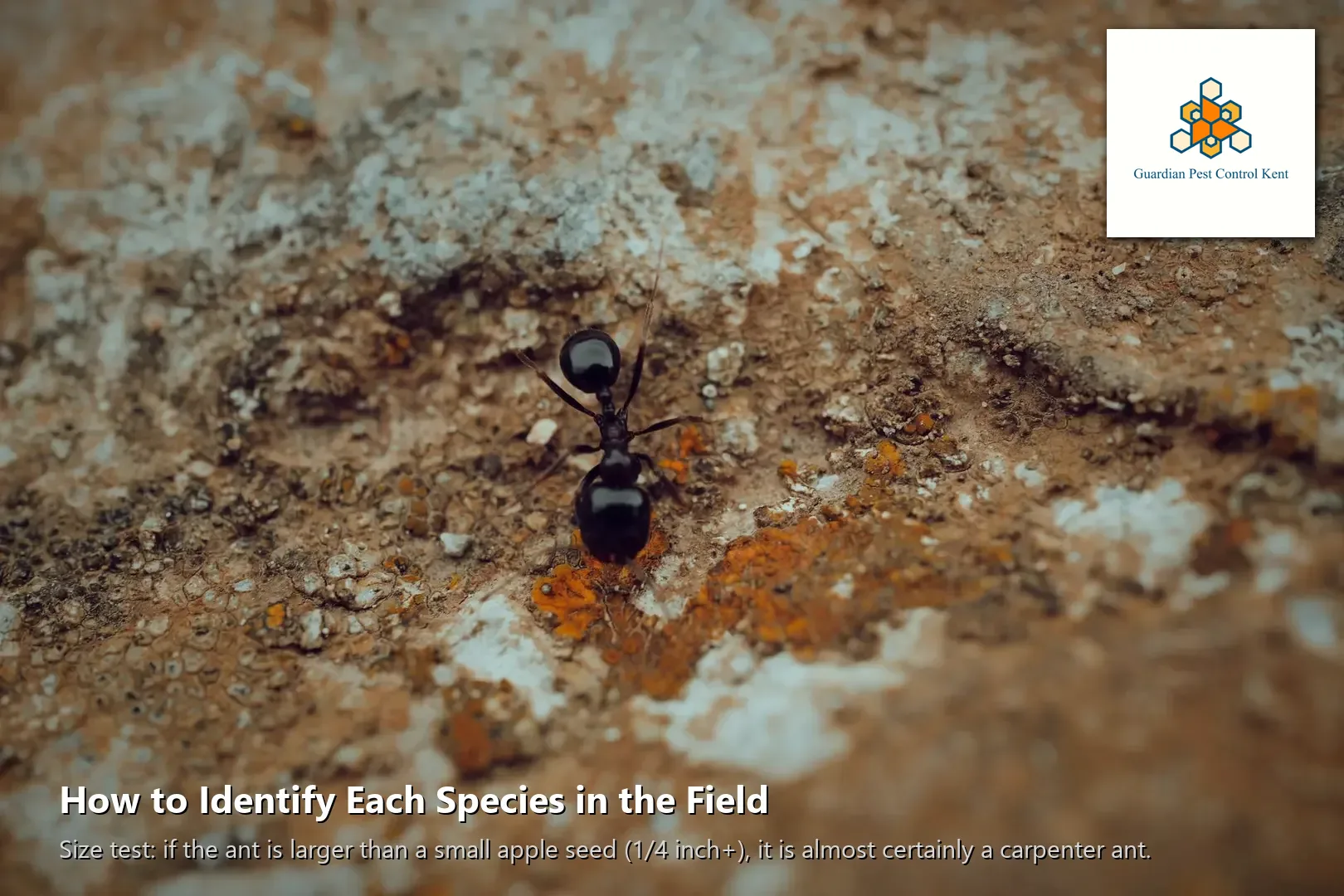
Thorax test: Place the ant in a clear container or photograph it from the side. A carpenter ant’s thorax forms a smooth, evenly-curved arc from head to abdomen - no bumps or indentations at the top. This smooth arc is a definitive identification feature visible without magnification.
Swarmer identification: Carpenter ant swarmers (winged reproductives) are large (1/2–3/4 inch including wings), entirely black, and have distinctly unequal wing pairs - the front wings are longer than the rear wings. Finding carpenter ant swarmers inside a Kent home in April–June indicates an established satellite colony in the building structure.
Identifying Odorous House Ants
Size test: If the ant is smaller than a sesame seed (1/8 inch or less), it is likely an odorous house ant in western Washington. This is the dominant small dark ant species in Kent homes.
Smell test: Crush a single ant between your fingers and smell immediately. Odorous house ants produce a strong, unambiguous rotten coconut or blue cheese odour from defensive chemicals (methyl ketones) released on death. This odour is consistent and noticeable - it is the most reliable field identification for the species.
Trail test: Odorous house ants trail in dense, erratic lines along edges - baseboards, countertop edges, pipe runs. Carpenter ants typically travel in single-file lines along defined routes and are most active at night.
What Carpenter Ants Indoors Mean for Your Kent Home
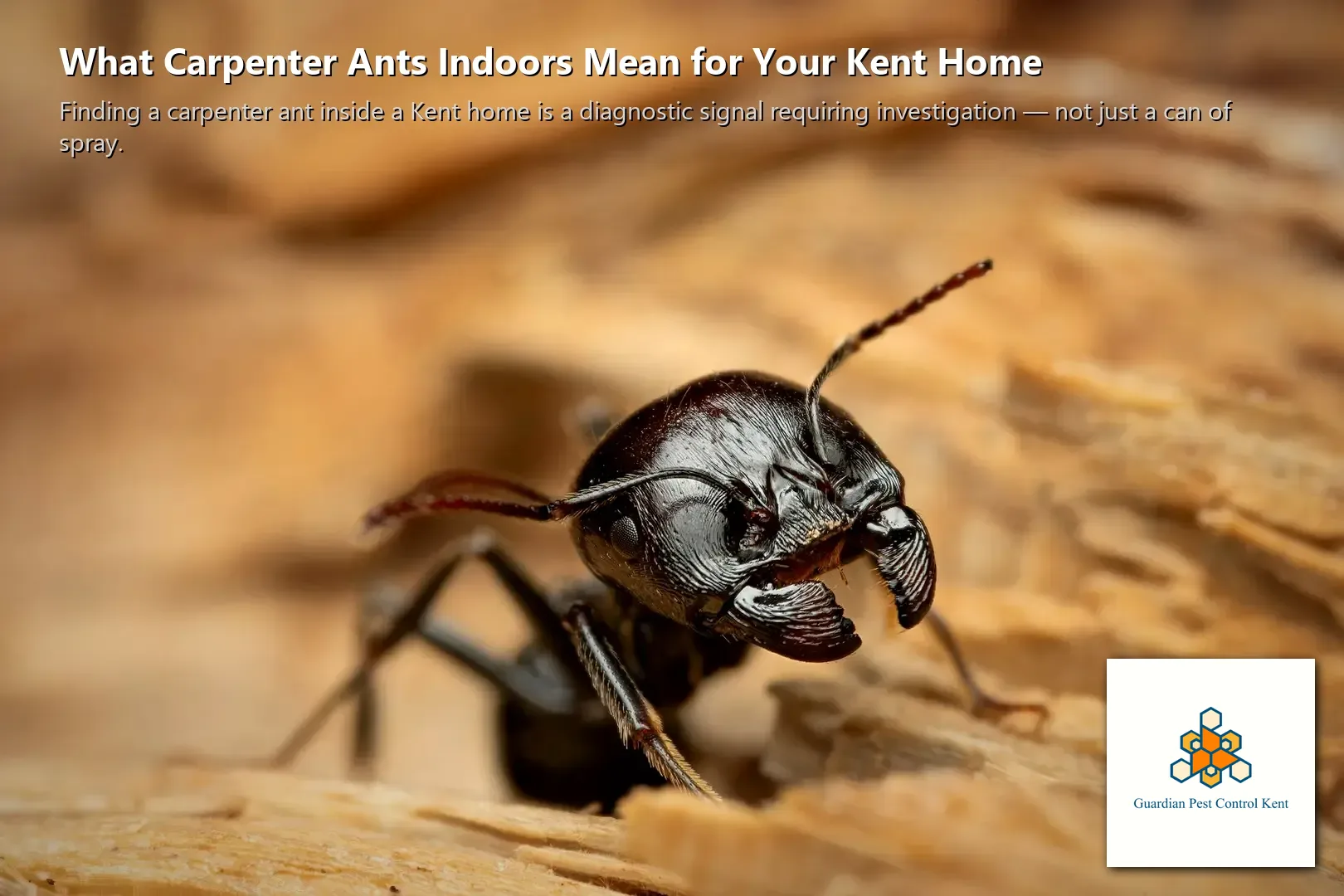
Finding a carpenter ant inside a Kent, WA home at any time of year is a diagnostic signal requiring investigation - not just treatment of the visible ant. Carpenter ants establish satellite colonies inside buildings exclusively in wood that has been softened by moisture exposure or fungal decay. A carpenter ant inside your wall means moisture has degraded the wood in that wall cavity enough to support nesting.
Common moisture sources that attract carpenter ants to Kent homes
- Failed roof flashing - water intrusion at the roof penetration (chimney, skylight, vent pipe) saturates the top plate and upper wall structure above the ceiling. Carpenter ant activity in the ceiling or attic frequently traces to a roof flashing failure that has been saturating wood for months before the ants appear.
- Clogged or leaking gutters - gutters that overflow against the fascia board saturate the wood behind the gutter continuously during rain events. Western Washington’s 38–42 inches of annual rainfall makes a clogged gutter a significant moisture source for the fascia and soffit structure.
- Crawl space moisture - inadequate crawl space ventilation or a failed vapour barrier allows ground moisture to saturate the floor joists from below. Carpenter ant activity in the crawl space or floor void is strongly associated with crawl space moisture problems in South King County homes.
- Window and door frame failures - failed exterior caulk around window frames allows water to intrude behind the frame into the rough opening and surrounding framing. Carpenter ant activity around window frames is a reliable indicator of this failure mode.
What Odorous House Ants Indoors Mean
Odorous house ants found inside a Kent, WA home indicate a foraging incursion from an outdoor or interior satellite colony attracted by a food or moisture signal. Odorous house ants do not require moisture-damaged wood to nest - they establish satellite colonies in any protected, temperature-stable void: wall insulation, kitchen cabinet bases, under flooring, and inside electrical boxes.
The presence of odorous house ants indoors does not indicate structural damage and does not require a building inspection. It does indicate that the colony has a food signal, a water source, and an entry point that have not been eliminated. Once odorous house ants are trailing continuously inside the home, the colony has established a satellite nest - prevention measures alone will not resolve the infestation, and professional gel bait treatment is required.
Treatment: Why the Same Approach Does Not Work for Both
Carpenter ant treatment
- Locate the satellite nest - follow frass accumulation, rub marks, and nighttime trail observation to the nesting gallery location.
- Inject with non-repellent insecticide - dust or foam insecticide injected directly into the gallery contacts the colony at the source. Delta dust (deltamethrin) and Drione (pyrethrins + silica) are common professional-grade products for this application.
- Treat the exterior perimeter - non-repellent liquid insecticide on the foundation perimeter kills workers travelling between the outdoor parent colony and the satellite. This reduces re-establishment pressure while exclusion is completed.
- Repair the moisture source - the carpenter ant’s reason for being inside the home is always moisture-softened wood. Repair the moisture entry before the ants re-establish the satellite.
- Remove or treat the outdoor parent colony - the parent colony (in a dead stump, log pile, or fence post) continues producing workers that will seek the interior satellite location. Treating or removing the parent colony reduces long-term reinfestation risk.
Odorous house ant treatment
- Do not spray the trails - repellent spray triggers budding: the colony splits into multiple new sub-colonies in adjacent areas, increasing total ant presence in the home.
- Apply slow-acting gel bait along foraging trails - workers carry the bait back to the colony and share it with nestmates and queens. Full colony elimination requires 3–6 weeks.
- Apply non-repellent perimeter treatment - kills surface foragers without triggering colony splitting; provides 60–90 day residual on exterior surfaces.
- Seal entry points and eliminate food/moisture signals - the colony will re-establish satellite nodes if the conditions that attracted it remain present after colony reduction.
When to Call a WSDA-Licensed Professional for Either Species
- Any carpenter ant found indoors - even a single individual - warrants a professional inspection to locate the nesting gallery
- Carpenter ant swarmers found inside in spring (April–June) - indicates an established interior satellite colony
- Frass found anywhere inside the home - immediate professional inspection required
- Odorous house ants trailing continuously for more than two weeks despite cleaning
- Odorous house ant activity that resumed within 2 weeks of a repellent spray application
- Any ant emerging from wall outlets, floor voids, or ceiling fixtures - indicates an interior nest, not foraging entry
Frequently Asked Questions
How do I tell a carpenter ant from a black ant in Kent, WA?
Carpenter ants measure 1/4–1/2 inch - 3 to 8 times larger than odorous house ants, which measure 1/16–1/8 inch. Both species are black or dark brown. The carpenter ant’s thorax forms a smooth, evenly-curved arc from the side with no bumps. Odorous house ants emit a strong rotten coconut odour when crushed. If the ant is larger than 1/4 inch, it is almost certainly a carpenter ant in the Kent, WA context.

Are carpenter ants more dangerous than odorous house ants?
For structural risk, yes - carpenter ants are significantly more dangerous. Carpenter ants excavate galleries in moist or damaged wood, removing structural fibres from floor joists, wall studs, and window frames over 2–5 years. Odorous house ants do not damage wood - they are a sanitation and food contamination concern. Carpenter ants found indoors require a professional inspection immediately.
What does carpenter ant frass look like in Kent, WA homes?
Carpenter ant frass consists of wood shavings, insect body parts, and soil particles - resembling coarse sawdust mixed with fine debris. Frass accumulates in small piles below the nesting gallery: under baseboards, below window frames, at ceiling/wall junctions, or in the crawl space. Finding frass inside a Kent home is a diagnostic finding requiring immediate professional inspection.
Can carpenter ants damage a house in Kent, WA?
Yes. A mature satellite colony inside a Kent, WA home can cause significant structural damage to floor joists, subflooring, wall framing, and window frames over a 2–5 year period. The structural risk is highest where carpenter ants excavate in load-bearing joists or in areas already weakened by moisture damage. Early treatment prevents damage that can cost $5,000–$20,000 to repair.
Do carpenter ants eat wood?
No. Carpenter ants excavate galleries in wood for nesting and discard the fibres as frass - they do not consume the wood. Carpenter ants eat insects, honeydew from aphids, and other organic matter. However, the structural damage from carpenter ant excavation is comparable to termite damage over the same time period when an established colony occupies structural wood.
Why do I have carpenter ants in my Kent, WA home?
Carpenter ants establish satellite colonies inside homes because moisture has created wood conditions suitable for nesting - moist or partially decayed wood. Common moisture sources include leaking roof flashing, clogged gutters overflowing against the fascia, inadequate crawl space ventilation, window flashing failures, and plumbing leaks inside wall cavities. Eliminating the carpenter ant colony without fixing the moisture source causes reinfestation within 12–24 months.
What is the treatment for carpenter ants vs odorous house ants?
Carpenter ants require nest identification and direct gallery injection with non-repellent insecticide dust or foam, followed by moisture source repair and exterior perimeter treatment. Odorous house ants require slow-acting gel bait treatment along foraging trails - the bait is carried back to the colony and kills the queen. Repellent sprays are ineffective for odorous house ants (triggers budding) and do not reach the carpenter ant gallery.
Summary
Carpenter ants and odorous house ants are the two most common dark-coloured ants in Kent, WA homes. Size is the primary identification feature - carpenter ants are 3–8 times larger than odorous house ants. Carpenter ants found indoors indicate a moisture problem and structural damage risk requiring immediate professional inspection. Odorous house ants require gel bait treatment once established inside; repellent sprays worsen this species through colony splitting. Correct species identification before treatment is the most important step in ant control for Kent, WA homeowners.
Guardian Pest Control provides WSDA-licensed ant control services in Kent, WA including definitive species identification, carpenter ant gallery location, moisture source assessment, gel bait treatment, and structural exclusion. For a full ant identification and treatment consultation, call (304) 684-6328 Monday–Saturday, 8 a.m. to 6 p.m., or book a free inspection online. Also see the Complete Guide to Ant Control in Kent, WA for the full species reference and treatment framework.
Sources
- WSU Extension - Carpenter Ants in Washington: extension.wsu.edu
- WSU Extension - Odorous House Ant Management: extension.wsu.edu
- EPA - Ant Management: epa.gov/safepestcontrol
- NPMA Pest Guide - Ants: npmapestworld.org