Key Takeaways
- Ant foraging in King County peaks May–July; treatment in April intercepts the spring expansion before indoor trailing establishes.
- Yellow jacket colonies grow from 30 workers in May to 5,000 in August - treating in June costs less and is safer than treating in September.
- Mosquito pressure in the Green River Valley peaks in June–July; eliminating residential standing water reduces breeding by 50–80%.
- Flea populations in South King County peak in July–August when larval development time is shortest in warm conditions.
- House spiders become more visible in July–September as juveniles mature and males wander searching for mates - not a new infestation but an existing population becoming visible.
- Washington State’s lack of extreme summer heat prevents the pest suppression that occurs in hotter climates.
- A single professional perimeter treatment in April addresses all summer pest categories simultaneously.
June: Ant Peak, Wasp Establishment, Mosquito Season Begins
Ants PEAK MONTH
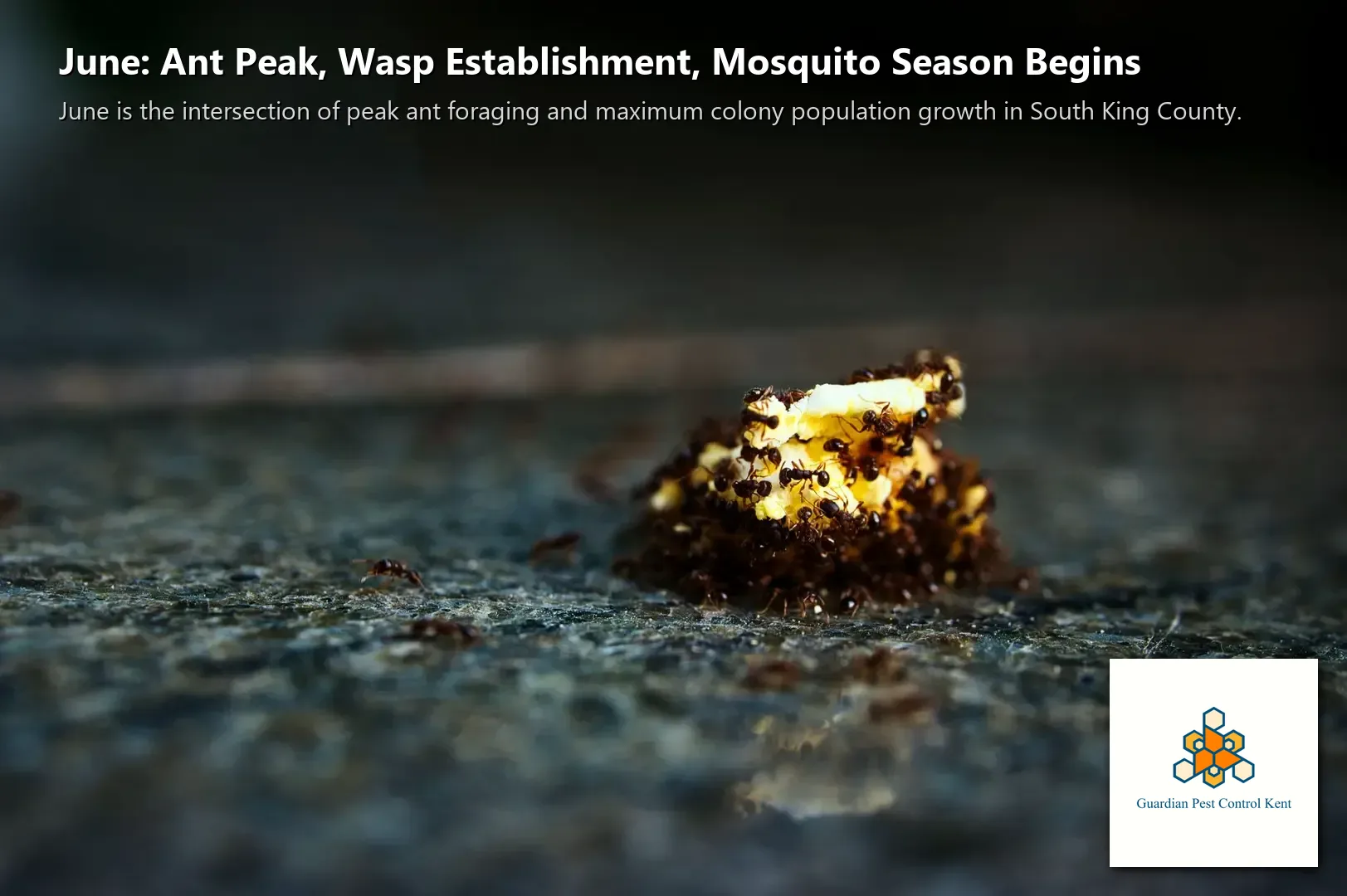
June represents the intersection of peak ant foraging and maximum colony population growth for South King County’s primary ant species. Odorous house ant colonies reach 30,000–100,000 workers by June, producing the highest foraging density of the year. The combination of warm temperatures, dry periods that concentrate food sources, and peak colony population explains why June generates the highest volume of ant infestation calls in western Washington.
Carpenter ant swarmers - the winged reproductive forms - emerge in large numbers during warm days in May and early June. Indoor carpenter ant swarmer events (finding winged ants inside the home) indicate an established satellite colony in the building structure. This is distinct from foraging workers entering from outside. Finding carpenter ant swarmers indoors in June requires a professional inspection to locate the satellite nest gallery before it expands further into structural wood.
June action: If perimeter treatment was not applied in April, apply now. Ant baiting inside is more intensive than a pre-season perimeter application but still effective. Related service: Ant Control Kent WA
Wasps and Yellow Jackets - Colony Growth Phase
June is the optimal treatment window for wasp colonies in Kent, WA. Yellow jacket colonies in June contain 200–500 workers - large enough to defend the nest but small enough to treat with a single aerosol or dust application. The same colony in September contains 3,000–5,000 workers and requires full personal protective equipment and professional application methods for safe treatment.
Bald-faced hornet nests become visible in June as foliage fills in around them. A football-sized grey paper nest in a tree or under an eave in June contains 200–300 workers. A professional June treatment involves one service visit. The same nest discovered in September typically requires two visits and may involve the use of pressurised dust equipment.
June action: Inspect all eaves, soffits, deck frames, and tree branches in the yard. Treat any nest found before July. Related service: Wasp and Hornet Removal Kent WA
Mosquitoes - Early Season
Mosquito season in the Green River Valley begins in mid-May and reaches its first peak in June when standing water from spring rains has warmed to 50°F - the threshold for Culex pipiens (northern house mosquito) larval development. The Green River floodplain, Soos Creek wetlands, Lake Meridian, and Clark Lake provide extensive public wetland breeding habitat managed by King County Vector Control. Residential breeding sites are the homeowner’s controllable variable.
The CDC and King County Public Health recommend eliminating all standing water on residential properties weekly during mosquito season. A single neglected bird bath or pot saucer with 1 teaspoon of standing water can support 100+ mosquito larvae through a full development cycle (7–10 days at 70°F).
June action: Audit all residential standing water sources weekly. Clean and flush gutters. Apply BTi (Bacillus thuringiensis israelensis) mosquito dunks in decorative water features that cannot be emptied. Related service: Mosquito Control Kent WA
July: Peak Mosquito Pressure, Wasp Colonies Growing
Mosquitoes PEAK MONTH
July is peak mosquito month in South King County. Soil temperatures in the Green River Valley reach their annual high in late July, maximising larval development speed. A mosquito egg to adult cycle that takes 14 days at 60°F completes in 7 days at 75°F. This temperature-driven development acceleration doubles the number of new adults produced per week from the same standing water volume.
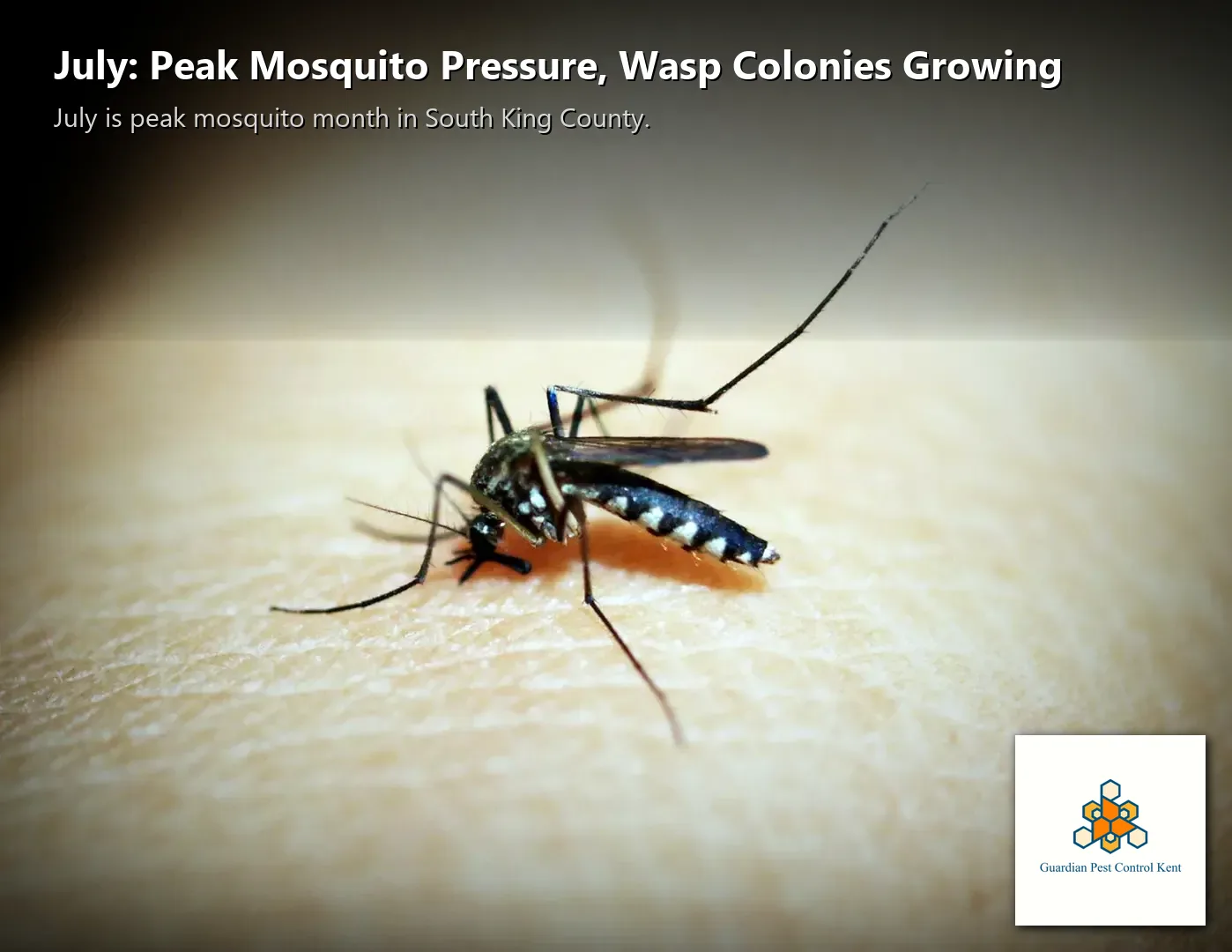
The primary mosquito species in King County - Culex pipiens - is the principal vector of West Nile Virus in Washington State. King County has recorded sporadic West Nile Virus detections in mosquito pools and birds in South King County. The Washington State Department of Health maintains surveillance data for West Nile Virus detections in all 39 counties. As of 2026, risk in King County remains low but non-zero during peak mosquito season.
Fleas - Population Building
Flea populations in South King County homes with outdoor pets begin building in July as warm conditions shorten the larval development time from 2–3 weeks to 1–2 weeks. Adult fleas on pets are the visible 5% of the flea population - the other 95% (eggs, larvae, pupae) is distributed through the home environment in carpets, bedding, and flooring gaps. A pet with 20 adult fleas produces 400 eggs per day - 2,800 eggs per week - that distribute through the home and develop into new adults on a 3–4 week cycle in July temperatures.
Treating the pet without treating the home environment eliminates only 5% of the flea population. Complete flea control requires simultaneous pet treatment (veterinarian-prescribed product), home vacuuming (which activates dormant pupae and accelerates the cycle toward adulthood for treatment), and an insect growth regulator (IGR) treatment of the home interior to prevent larval development. Related service: Flea and Tick Control Kent WA
August: Yellow Jacket Season Peaks, Spiders Mature
Yellow Jackets PEAK AGGRESSION
August is the most dangerous month for yellow jacket encounters in King County. Colony populations peak at 3,000–5,000 workers in late August. Worker behaviour shifts from colony growth (foraging for protein to feed larvae) to colony defence as the colony’s reproductive cycle approaches its end. This shift coincides with declining natural food sources, which drives workers to scavenge at outdoor dining areas, garbage bins, and picnic sites where human contact is high.
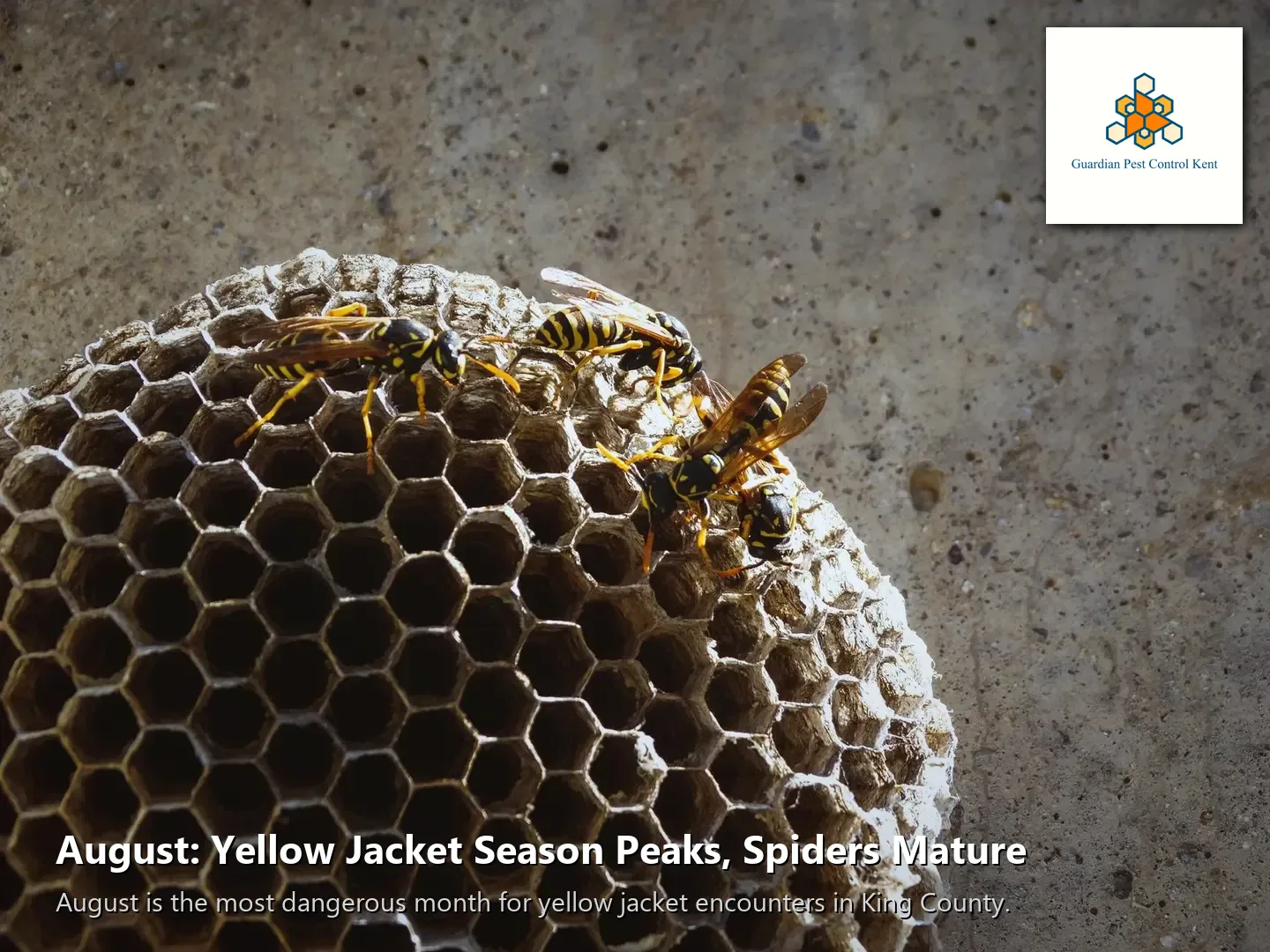
Yellow jacket stinging incidents in King County are concentrated in August and September. King County Public Health documents stinging insect encounters as the most common summer outdoor emergency in the county, with anaphylaxis-related hospitalizations occurring every year in South King County. Individuals who have experienced a previous allergic reaction to wasp or bee stings should carry a prescription epinephrine auto-injector during all outdoor activities in August and September.
Spiders - Increased Visibility
House spider sightings in Kent homes increase in August and September as juvenile spiders from spring hatching mature and male spiders of many species begin wandering in search of mates. This increase in spider visibility does not indicate a new infestation - it reflects the maturation and dispersal of a spider population that has been present throughout the summer. Large brown spiders found in Kent homes in August and September are typically giant house spiders (Eratigena atrica) or hobo spiders (Eratigena agrestis) - both harmless to humans under current WSU research findings.
The presence of large numbers of spiders indoors is a secondary indicator. Spiders follow their prey - if substantial numbers of spiders are present, a prey insect population (flies, ants, or other small insects) is sustaining them. A spider investigation in August that reveals large numbers indoors warrants an inspection for the underlying prey insect source. Related service: Spider Control Kent WA
Summer Pest Prevention Calendar for Kent, WA Homeowners
| Month | Priority action | Target pest |
|---|---|---|
| April | Professional perimeter treatment | Ants, overwintering queen wasps, spiders |
| May | Wasp nest inspection and early treatment | Yellow jackets (young colonies) |
| June | Mosquito standing water audit (weekly); wasp nest treatment | Mosquitoes, wasps |
| July | Flea prevention if outdoor pets present; mosquito audit continues | Fleas, mosquitoes |
| August | Yellow jacket nest treatment before peak aggression; professional wasp service if delayed | Yellow jackets |
| September | Rodent exclusion check; perimeter retreatment before autumn | Rodents, overwintering spiders |
Why Washington State Summer Is Different From Inland US
Washington State’s Pacific coast climate produces a summer pest environment that differs from most of the United States in two significant ways.
First, western Washington’s summer temperatures do not suppress pest activity. States with sustained temperatures above 95°F in July and August experience partial pest suppression - many species reduce surface activity during the hottest part of the day. Kent, WA averages a high of 81°F in July, maintaining conditions that support continuous pest activity without any heat-driven suppression window.
Second, the transition from the wet spring to the dry summer drives ant, wasp, and mosquito populations to expand toward residential water and food sources as outdoor resources shift. This expansion phase - May through July - is the highest-pressure period for all three species simultaneously. A homeowner with no ant, wasp, or mosquito problem in April frequently experiences all three by July if preventive treatment was not applied in the spring.
Frequently Asked Questions
What pests are most common in summer in King County, WA?
The most common summer pest pressures in King County, WA are: odorous house ants (peak May–July), yellow jackets and bald-faced hornets (peak August–September), mosquitoes near the Green River and Lake Meridian watershed (peak June–July), fleas in homes with outdoor pets (peak July–August), and house spiders increasing in visibility as they mature (July–September). Rodent pressure remains constant year-round in South King County.
Are there mosquitoes in Kent, WA?
Yes. Kent, WA and the surrounding Green River Valley experience moderate mosquito pressure from June through August. The primary breeding habitat is standing water in the Green River floodplain, Soos Creek wetlands, and Lake Meridian. King County Vector Control Division monitors and treats public water bodies, but residential standing water is the controllable residential breeding source. The primary mosquito species in King County is Culex pipiens (northern house mosquito).
When do yellow jackets become aggressive in Washington State?
Yellow jackets in Washington State become most aggressive in late August and September when the colony reaches maximum population (3,000–5,000 workers) and natural food sources begin to decline. Reduced food availability pushes workers to scavenge at outdoor dining areas and garbage bins, increasing human contact. Colony aggression is highest in September as the seasonal cycle ends.
Do fleas infest homes without pets in Washington State?
Yes. Fleas infest homes without pets when a previous resident had pets, when wildlife (rats, squirrels, raccoons) accesses the crawl space or attic, or when a new resident moves into a property with a dormant flea egg population in carpets or flooring. Flea pupae can remain dormant for up to 6 months without a host before a mass hatching event.
Are spiders in Kent, WA dangerous in summer?
The vast majority of spiders in Kent, WA are harmless to humans. The western black widow (Latrodectus hesperus) is present in South King County and is a genuine medical concern. Black widow spiders in the Kent area are found in undisturbed exterior locations - wood piles, under decking, inside dark storage sheds. Current WSU research indicates hobo spider venom does not cause tissue necrosis under clinical conditions.
What is the best pest prevention for summer in South King County?
The three highest-impact summer pest prevention measures for South King County homes are: (1) a professional perimeter insecticide treatment in April–May; (2) elimination of all residential standing water sources weekly to reduce mosquito breeding; and (3) a professional wasp nest inspection and treatment in June before colonies reach dangerous population sizes. A quarterly pest control programme covers all three seasonal priorities.
Why are there more ants in summer in my Kent, WA home?
Ant foraging activity increases in summer because colony populations reach their annual peak between May and July, producing more foraging workers per colony. Increased human activity and summer heat driving ants to seek cooler indoor environments for satellite colony establishment both contribute to the typical summer spike in ant infestation calls in Kent, WA.
Summary
Summer pest pressure in King County and South King County spans multiple species simultaneously - ants, wasps, mosquitoes, fleas, and spiders - with each species peaking in a distinct window from May through September. Prevention is always more effective and less expensive than treatment after populations peak. A professional perimeter treatment in April addresses all primary summer pest categories in a single service visit.
Guardian Pest Control serves Kent, WA and the South King County area with WSDA-licensed residential pest control programmes covering all summer pest categories. Service areas include Auburn, Renton, Federal Way, Burien, and Bellevue. Call (304) 684-6328 Monday–Saturday, 8 a.m. to 6 p.m., for a free seasonal consultation or book online.
Sources
- King County Vector Control Division: kingcounty.gov
- Washington State Department of Health - West Nile Virus: doh.wa.gov
- WSU Extension - Pest Management: extension.wsu.edu
- CDC - Mosquito Control: cdc.gov/mosquitoes
- NPMA Pest Guide: npmapestworld.org