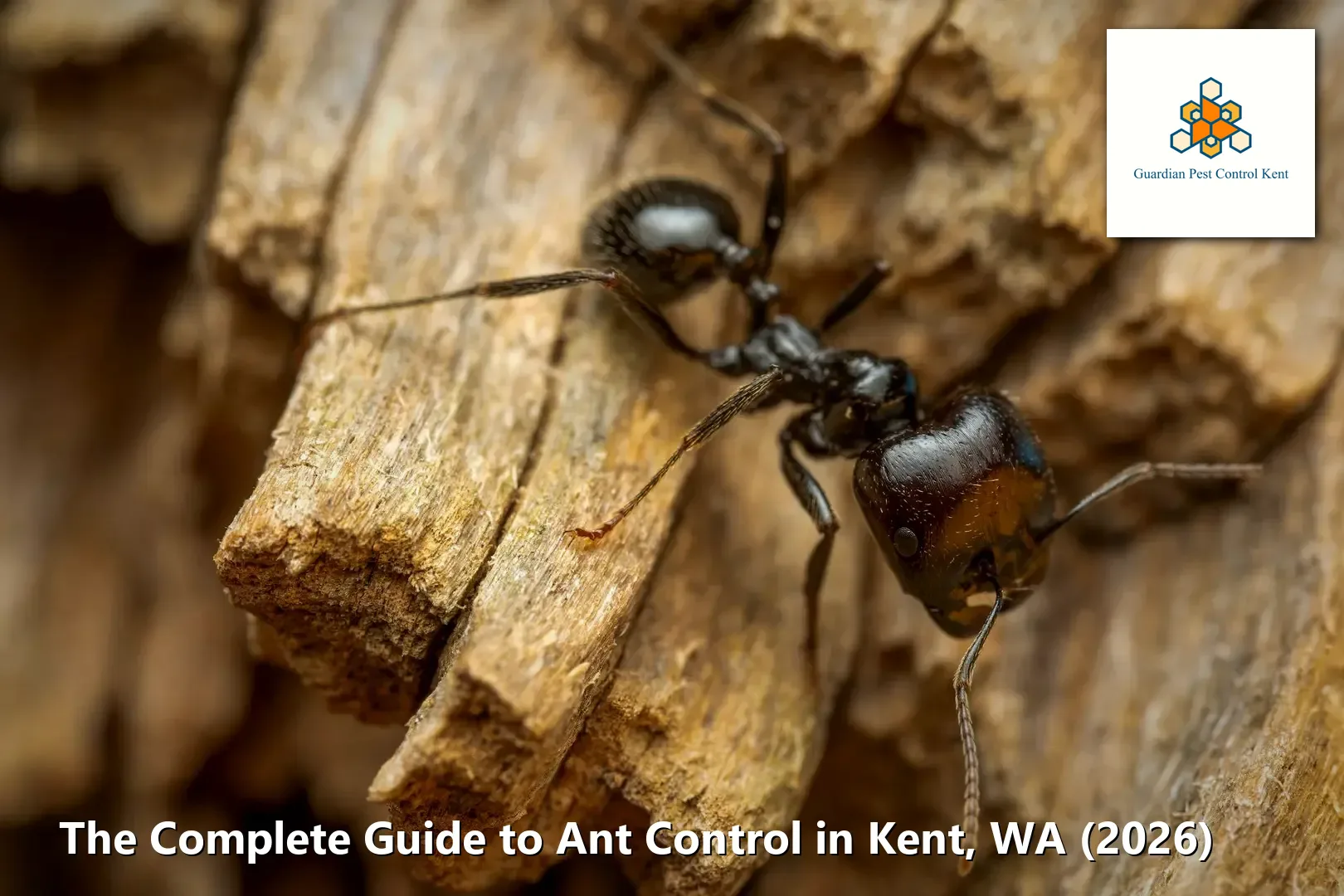
This guide covers every aspect of ant control relevant to Kent homeowners and commercial property managers: species identification, biology, why common DIY approaches fail, professional treatment methods, optimal timing, and prevention practices that reduce re-infestation risk.
Key Takeaways
- Four ant species cause the majority of structural problems in Kent, WA: odorous house ant, carpenter ant, pavement ant, and moisture ant.
- Repellent sprays trigger colony splitting in odorous house ants - the colony multiplies rather than retreats.
- Carpenter ants indicate a moisture problem; treating the ants without fixing the moisture source causes reinfestation within months.
- Gel bait is the most effective treatment for odorous house ants - workers carry it back to the queen.
- March–April is the optimal treatment window in Kent, WA, before the spring foraging expansion.
- A 12-inch mulch-free zone around the foundation is the most effective single prevention measure.
- WSDA-licensed technicians can distinguish species by trail behaviour and frass examination - correct identification determines correct treatment.
Ant Species in Kent, WA: Identification Guide
Correct species identification is the most important step in ant control. Treatment that eliminates one species may be completely ineffective against another. The four species most commonly encountered in Kent homes each require a different primary treatment strategy.
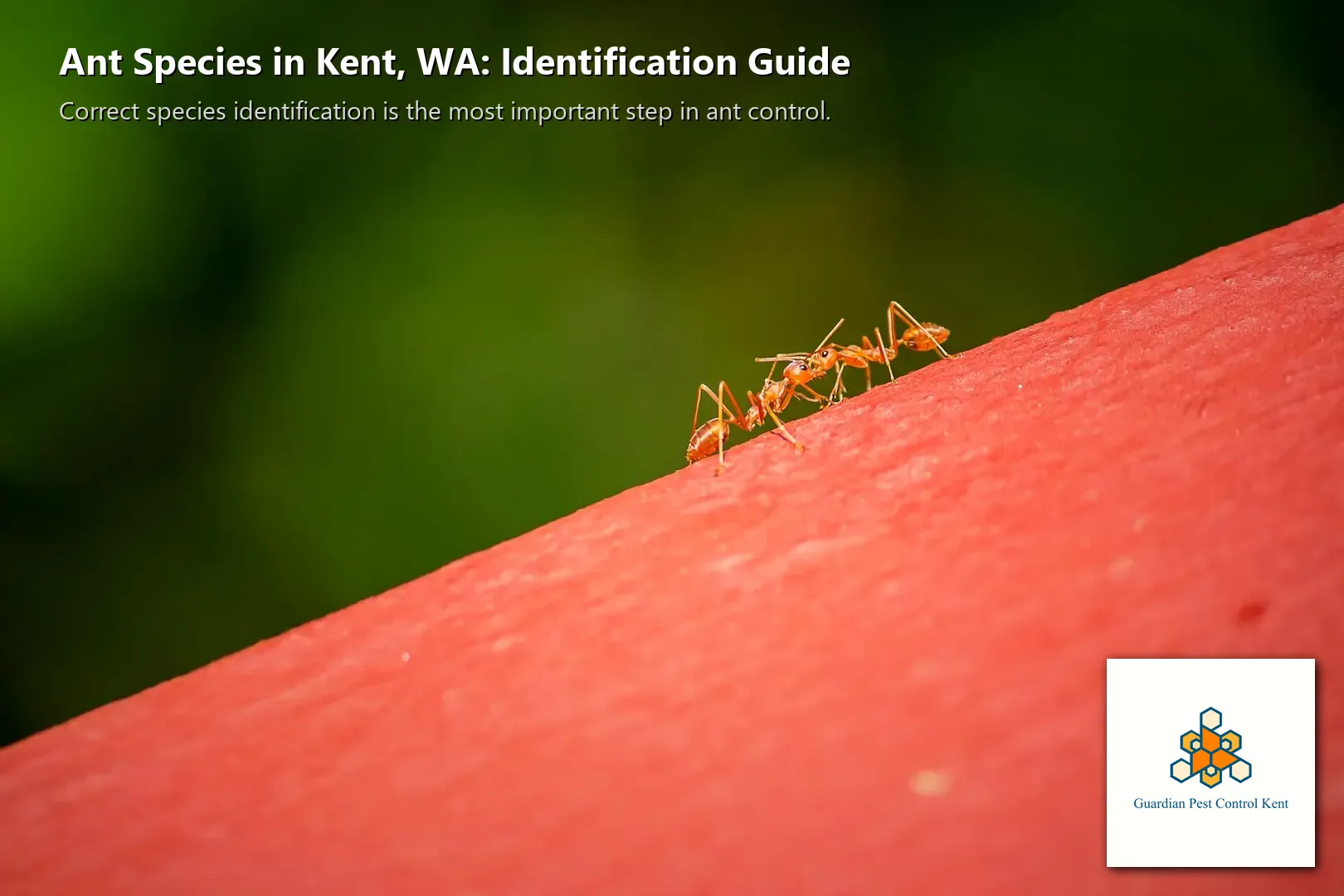
1. Odorous House Ant (Tapinoma sessile)
Size: 1/16–1/8 inch | Colour: Dark brown to black | Defining trait: Rotten coconut odour when crushed
The odorous house ant is the primary structural ant pest in Kent, WA and the most common indoor ant in all of western Washington. Colonies range from 10,000 to 100,000 workers and maintain multiple queens, allowing rapid colony multiplication. Odorous house ant colonies form networks of interconnected sub-colonies that share workers and resources - a behaviour called unicoloniality - which means eliminating one nest location does not eliminate the colony.
Odorous house ants trail along defined routes following chemical pheromone paths. They enter Kent homes through foundation cracks, around utility penetrations, and through ground-level window frames. They feed primarily on carbohydrates - sweet foods, honeydew from aphids on indoor plants, and sugary residues on kitchen surfaces.
Correct treatment: Slow-acting sugar-based gel bait placed along foraging trails. Workers carry the bait back to the colony and share it with nestmates and queens. Do not spray foraging trails - repellent insecticides trigger budding.
2. Carpenter Ant (Camponotus modoc and C. vicinus)
Size: 1/4–1/2 inch | Colour: Black or black and red | Defining trait: Largest ant in the region; excavates wood galleries
Carpenter ants are the second most common structural ant pest in Kent, WA and the most costly in terms of property damage. Camponotus modoc - the western black carpenter ant - is the primary species in South King County. Carpenter ants do not eat wood; they excavate clean, smooth-walled galleries in moist or decayed wood and discard the fibres as frass - a mixture of wood shavings and insect body parts resembling coarse sawdust.
Finding carpenter ant frass in a Kent home is a diagnostic event. Frass accumulation below a wall void, under a window frame, or in a corner of the attic indicates an active satellite colony. The parent colony is always located outdoors - typically in a dead tree stump, a log pile, or decayed wood near the foundation. Satellite colonies inside the home are established by workers from the parent colony and may not contain a queen.
Correct treatment: Locate the satellite nest through frass evidence and trail observation. Treat with non-repellent insecticide injected directly into the gallery. Eliminate the moisture source attracting the colony - leaking roof flashing, clogged gutters, or crawl space moisture accumulation. Repair or remove the outdoor parent colony location to prevent re-establishment.
3. Pavement Ant (Tetramorium caespitum)
Size: 1/16–1/8 inch | Colour: Dark brown | Defining trait: Nests under concrete slabs, driveways, and pavers; small dirt mounds
Pavement ants are common in Kent residential areas with concrete driveways, patios, and paths. Colonies establish under the concrete itself, with workers foraging through expansion joints and cracks in the slab. Pavement ants enter homes through floor-level cracks, plumbing penetrations through the slab, and utility conduit gaps. They are omnivorous and will trail to any food source - grease, protein, and sweets.
Correct treatment: Perimeter granular bait around the foundation perimeter and along the slab edge. Crack-and-crevice treatment at expansion joints with non-repellent insecticide. Sealing the primary entry cracks in the concrete slab after colony reduction.
4. Moisture Ant (Lasius spp.)
Size: 1/8 inch | Colour: Yellow-brown | Defining trait: Associated with water-damaged wood; excavates galleries in softened wood only
Moisture ants are a diagnostic indicator - their presence inside a Kent home indicates water-damaged wood, not simply a foraging incursion. Moisture ants excavate galleries exclusively in wood softened by fungal decay. Finding moisture ants inside wall voids, under the flooring, or in the crawl space points directly to an active moisture problem: a leaking pipe, failed waterproofing, or inadequate crawl space ventilation.
Correct treatment: Eliminating the ant infestation without fixing the moisture source is a temporary measure. The primary treatment is identifying and repairing the moisture entry - plumbing leak, inadequate crawl space vapour barrier, or poor drainage. Once the wood dries, moisture ants cannot sustain the colony. A pest control specialist and a building contractor often work in parallel on moisture ant cases.
Why DIY Ant Control Fails in Western Washington
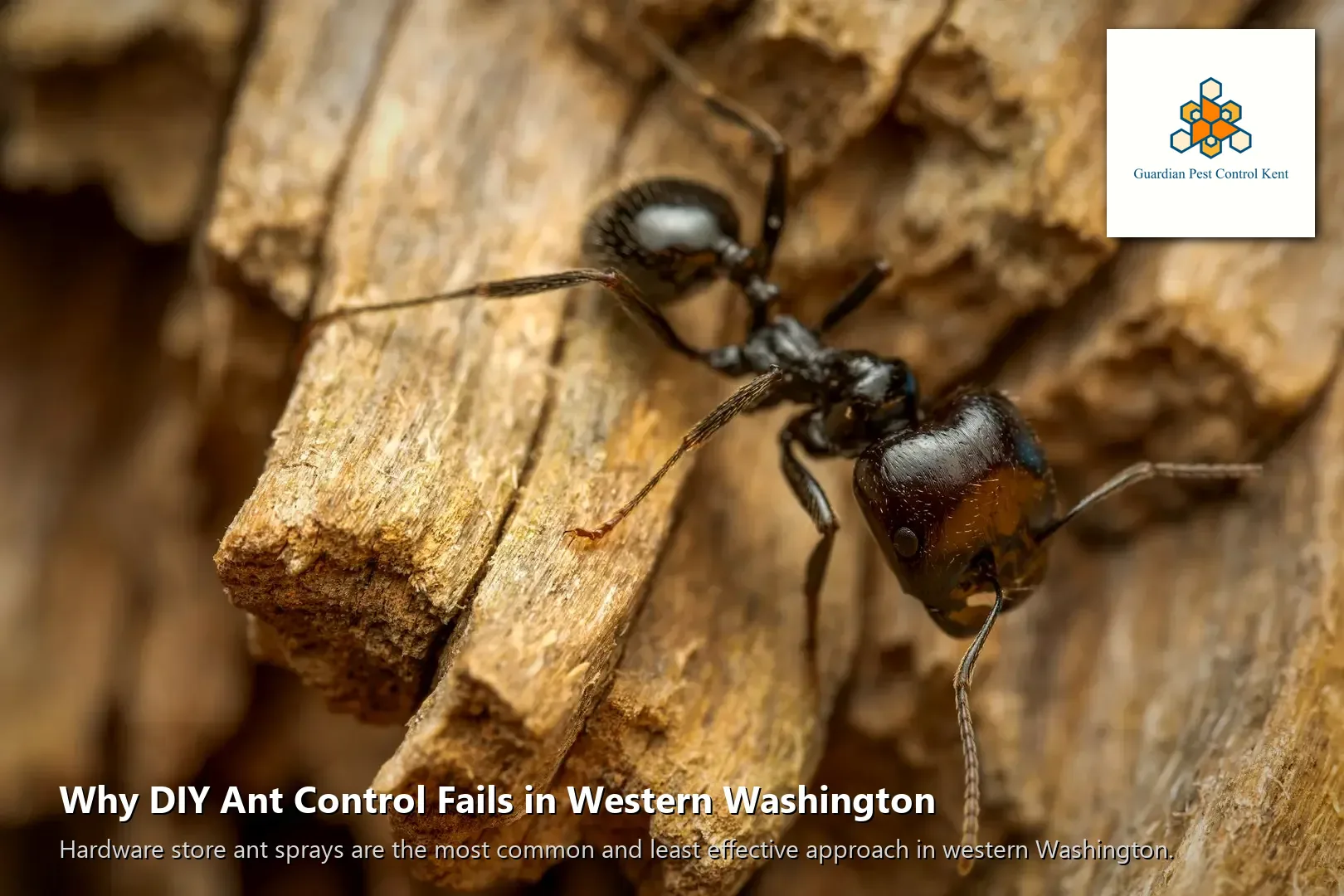
Hardware store ant sprays are the most common and least effective ant control approach in western Washington. Three specific failure modes explain why repellent sprays consistently underperform against Kent’s primary ant species.
Colony splitting (budding) in odorous house ants
Odorous house ant colonies react to repellent insecticide exposure by fragmenting. Workers carrying larvae and reproductives split away from the treated area and establish new sub-colonies in adjacent zones. A single colony treated with repellent spray can generate three to five new sub-colony nodes within two weeks. Each node develops into an independent foraging unit with its own queen. The homeowner observes a brief reduction in ant activity followed by activity emerging from multiple new locations.
Contact-only killing fails to reach the queen
A colony of 50,000 odorous house ants sends 10–20% of its workforce out foraging at any time - 5,000–10,000 workers. Spray killing every foraging worker visible does not reduce the colony’s reproductive capacity. The queen continues producing workers at 200–300 eggs per day. The colony replaces killed foragers within 2–3 weeks without any disruption to colony growth.
Incorrect bait formulation
Over-the-counter ant baits use gel or granule formulations with a fixed attractant - typically sugar or corn syrup. Ant colonies cycle through protein and carbohydrate feeding phases depending on colony nutritional needs. A sugar-based bait placed when the colony is in a protein-feeding phase is largely ignored. Professional technicians use rotation baiting - alternating sugar, protein, and lipid-based formulations - to match the colony’s current nutritional preference and maintain bait uptake throughout the treatment period.
Professional Ant Treatment Methods
Gel bait treatment - the primary tool for odorous house ants
Slow-acting gel bait remains the most effective method for eliminating odorous house ant colonies in Kent homes. The active ingredient (typically fipronil, indoxacarb, or abamectin) has a delayed kill time of 24–72 hours. This delay is essential - it allows the worker to return to the colony and share the bait with nestmates and queens through trophallaxis (food sharing). A fast-acting bait kills the worker before it returns, losing the delivery mechanism.
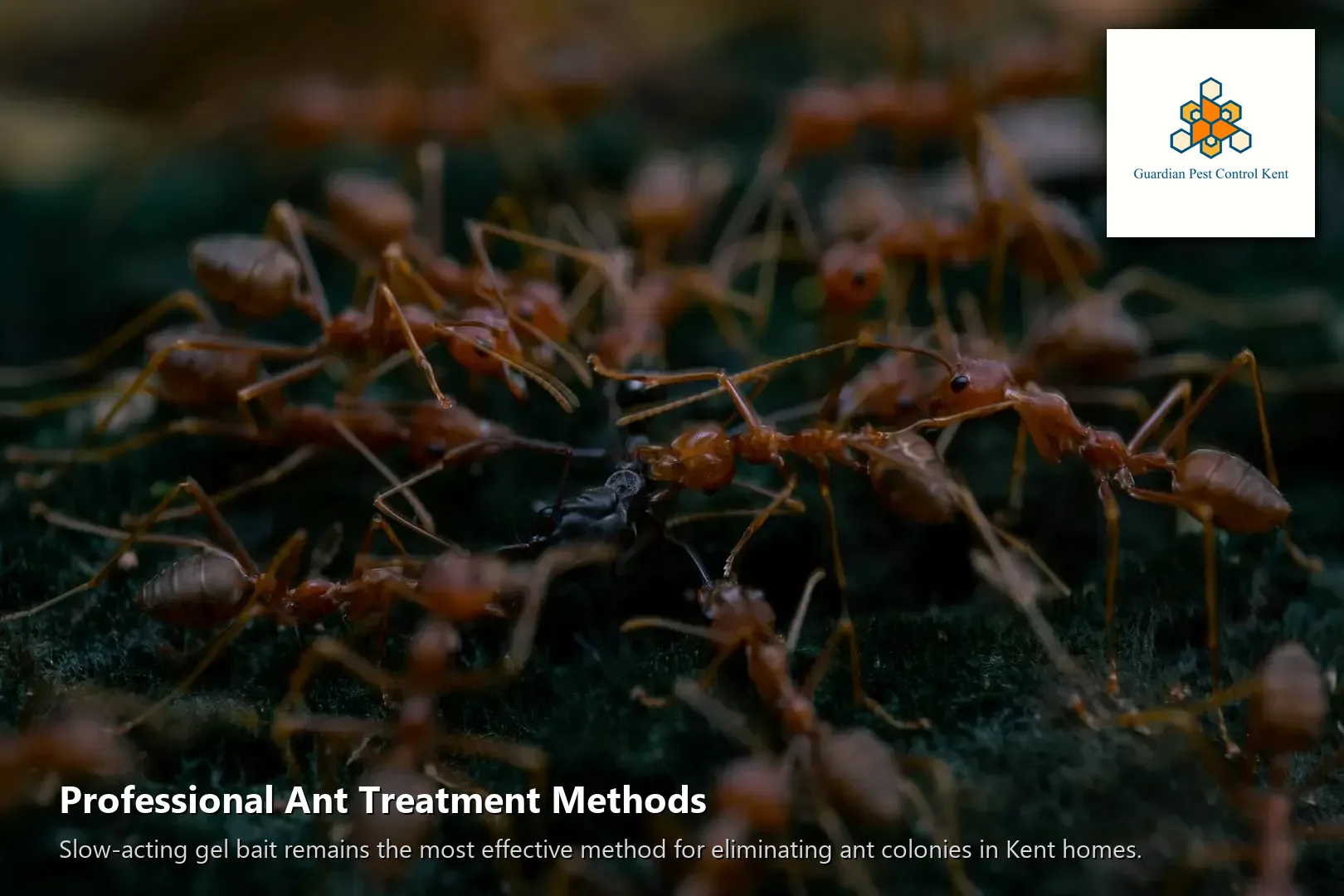
A professional technician places gel bait in pea-sized dots along active foraging trails, at entry points, and in the voids where trailing is heaviest. Bait stations are checked at 7 and 14 days. Active consumption indicates an effective formulation; refusal triggers a formulation change to match the colony’s current feeding preference.
Non-repellent perimeter treatment
Non-repellent insecticides (fipronil, chlorfenapyr) applied at the foundation perimeter kill surface-foraging ants without triggering colony splitting. Workers walk through the treated zone, pick up a sub-lethal dose, and return to the colony where the product is transferred to nestmates. Non-repellent treatments provide 60–90 days of residual protection on exterior surfaces in western Washington’s rainfall conditions.
Direct nest treatment for carpenter ants
Carpenter ant satellite nests identified by frass accumulation and trail mapping receive direct gallery injection with a non-repellent dust or foam insecticide. The product disperses through the gallery network, contacting the colony. This approach provides immediate knock-down of the satellite colony while the longer-duration perimeter treatment addresses re-entry from the outdoor parent colony.
Exclusion - the permanent component
Chemical treatment eliminates the current colony. Exclusion prevents the next one. A comprehensive exclusion service for a Kent home includes:
- Sealing all foundation cracks wider than 1/16 inch with silicone or elastomeric caulk
- Installing door sweeps and weatherstripping on all ground-level entry points
- Sealing around all pipe, conduit, and cable penetrations through the sill plate and foundation
- Recommending mulch removal from the 12-inch foundation perimeter zone
- Identifying and recommending repair of moisture sources that attract carpenter and moisture ants
Ant Control Treatment Timing in Kent, WA
| Timing | Treatment type | Primary purpose |
|---|---|---|
| March–April | Exterior perimeter treatment + bait placement | Intercept spring foragers at foundation before indoor trailing establishes |
| May–June (if active) | Interior bait treatment + trail mapping | Eliminate established indoor trails; treat satellite carpenter ant nests |
| July–August | Perimeter retreatment (rain degrades residual) | Refresh exterior barrier after summer rainfall breaks down product |
| October | Perimeter treatment | Target overwintering queen ants at foundation before first frost |
The March–April window is the most strategically valuable. Soil temperature in Kent, WA reaches 50°F in late March, triggering ant colony activation. A perimeter treatment applied at this threshold creates a chemical barrier at the foundation line before workers have established indoor foraging trails. Treating in May or June - after trailing is already established indoors - requires more intensive interior treatment and produces slower visible results.
Ant Prevention for Kent, WA Homes
Exterior - foundation and landscaping
- Maintain a 12-inch mulch-free zone around the entire foundation perimeter. WSU Extension identifies mulch as the primary ant harborage factor in residential settings in the Pacific Northwest.
- Remove wood-to-soil contact from all structural elements - fence posts, deck frames, and firewood piles should not contact the soil directly against the foundation.
- Trim tree branches so no limb contacts the roofline - carpenter ants use overhead branch bridges to access roof and attic spaces without crossing the treated perimeter.
- Fix exterior moisture issues - clean and extend downspout extensions, repair gutter leaks, and grade soil away from the foundation to eliminate moisture accumulation at the sill plate level.
- Remove outdoor food sources - secure compost bins with lids, clean up fallen fruit, and store pet food in sealed containers.
Interior - food, entry points, and moisture
- Store all food in sealed hard-sided containers - cardboard and soft plastic are accessible to foraging ants. This is the most important indoor prevention step for odorous house ants.
- Wipe kitchen surfaces daily - even invisible sugar residues from cooking or drink spills provide an adequate food signal for odorous house ant scouts.
- Fix plumbing leaks immediately - any persistent moisture under sinks, around the dishwasher, or at the water heater base creates the conditions that attract both odorous house ants and moisture ants.
- Seal interior penetrations - pipe gaps under sinks, around the HVAC system, and at baseboards provide direct ant access from the wall void to the kitchen and bathroom.
When to Call a Professional for Ants in Kent, WA
Call a WSDA-licensed pest control company when:
- Ant activity has continued for more than two weeks despite DIY treatment
- Multiple ant trails are present in different rooms simultaneously
- Large black ants (1/4 inch or larger) are found indoors - carpenter ant indicator
- Sawdust-like frass is found in any interior location
- Ants are emerging from wall outlets, floor voids, or ceiling fixtures
- Activity resumes within 2 weeks of a repellent spray application
A professional inspection maps all entry points, identifies the species definitively by morphology and trail behaviour, and determines whether an indoor nest is present. This information drives treatment selection - one inspection call prevents multiple ineffective DIY attempts.
Frequently Asked Questions
What is the most common ant in Kent, WA homes?
The odorous house ant (Tapinoma sessile) is the most common ant species in Kent, WA homes and throughout western Washington. Odorous house ants measure 1/16–1/8 inch, are dark brown to black, and emit a rotten coconut odour when crushed. Colonies range from 10,000 to 100,000 workers and maintain multiple queens, making them difficult to eliminate without professional gel bait treatment.
Why do ant sprays from the hardware store not work?
Repellent insecticide sprays kill foraging workers but do not reach the queen or the brood in the nest. Spraying foraging trails also triggers budding in multi-queen species like odorous house ants - the colony splits into two or more new colonies, each with its own queen, increasing the total ant population in the home. Professional treatment uses slow-acting gel bait that workers carry back to the nest, killing the queen and eliminating the source colony.
Are carpenter ants in Kent, WA dangerous to my home?
Yes. Carpenter ants excavate galleries in wood to nest, removing structural fibres in the process. A mature carpenter ant satellite colony inside a Kent home can damage floor joists, wall studs, and window frames over 2–5 years. Colonies found indoors require structural inspection to identify all nesting galleries before treatment.
How long does professional ant treatment take to work?
Gel bait treatment for odorous house ants typically reduces foraging activity by 70–90% within 7–14 days as workers carry bait back to the colony. Full colony elimination takes 3–6 weeks. Perimeter residual treatment shows results within 24–48 hours for surface-foraging ants. Carpenter ant treatment requires 2–4 weeks when baiting is used; immediate results occur with direct nest injection.
When should I treat for ants in Kent, WA?
The optimal treatment window for ant control in Kent, WA is March through early April - before soil temperatures exceed 55°F and before colony expansion pushes foragers deep into the home interior. Spring treatment intercepts workers at the foundation before trailing is established indoors. Autumn treatment (October) targets overwintering queens at the perimeter, reducing spring populations the following year.
How do I find where ants are entering my Kent home?
Follow the ant trail backward from where workers are foraging. Odorous house ants travel in defined trails along edges - baseboards, pipe runs, window sills - toward their entry point. Common entry points in Kent homes include: expansion joints between the concrete slab and foundation wall, conduit and pipe penetrations through the sill plate, gaps in window and door weatherstripping, and cracks in the mortar at foundation level.
Does mulch cause ant problems in Kent, WA?
Yes. Wood chip mulch against the house foundation creates ideal nesting habitat for odorous house ants and carpenter ants - it retains moisture, provides insulation, and contains decaying organic matter. WSU Extension recommends maintaining a 12-inch mulch-free zone adjacent to the foundation and keeping mulch depth below 3 inches to reduce moisture accumulation.
Summary
Effective ant control in Kent, WA starts with species identification, uses the correct treatment for each species, targets the queen’s colony rather than surface workers, and pairs chemical treatment with exclusion and prevention measures. Odorous house ants require slow-acting gel bait; carpenter ants require nest identification and moisture source repair; pavement ants respond to perimeter granular treatment. March–April treatment timing intercepts spring colony expansion before indoor trailing establishes.
Guardian Pest Control provides WSDA-licensed ant control services in Kent, WA with species identification, targeted bait treatment, perimeter application, and exclusion services. The residential pest control programme includes quarterly treatments that maintain a continuous ant barrier across all four seasonal activity periods. Call (304) 684-6328 Monday–Saturday, 8 a.m. to 6 p.m., or book a free inspection online.
Sources
- WSU Extension - Ants in and Around the Home: extension.wsu.edu
- EPA - Ant Control: epa.gov/safepestcontrol
- King County Environmental Health Division: kingcounty.gov
- NPMA Pest Guide - Ants: npmapestworld.org