Key Takeaways
- Odorous house ants detect food signals through cardboard and soft plastic packaging - only sealed hard-sided containers block access.
- Invisible sugar residues on countertops are sufficient to attract foraging scouts - daily wiping with detergent is required, not weekly.
- The gap around the drain pipe under the kitchen sink is the most common ant entry point into a Kent home kitchen.
- Persistent moisture under the sink or at the dishwasher attracts ants independent of food - repair drips immediately.
- Mulch directly against the foundation outside the kitchen wall creates ant nesting habitat 6 inches from the entry point.
- DIY sprays on kitchen trails trigger colony splitting - use gel bait if ants are already trailing indoors.
- Western Washington’s year-round mild temperatures mean kitchen ant pressure does not stop in winter.
How Ants Find Your Kitchen
Odorous house ant colonies send foraging scouts in all directions from the nest continuously. A single scout detecting a food signal - sugar, grease, or protein - returns to the colony and lays a pheromone trail to the source. Additional workers follow the trail, reinforcing the pheromone signal with each return trip. A small sugar spill on a Kent kitchen countertop can generate a trail of 200–300 foraging ants within 4 hours of the first scout’s discovery.
Three attractants draw ants to kitchens specifically:
- Food signals - sugars, proteins, and fats from cooking residues, open packaging, fruit, pet food, and compost
- Moisture - ant colonies require consistent access to water; kitchens with any persistent drip become a year-round destination
- Warmth - kitchen appliances (dishwashers, refrigerators, ovens) generate heat that attracts colonies to establish satellite nests in adjacent wall voids
Removing all three attractants simultaneously is the complete prevention approach. Removing only food signals without addressing moisture allows the colony to persist. Removing food and moisture without sealing entry points delays reinfestation by days, not weeks.
Food Storage: The Primary Prevention Step
Every food item in a Kent, WA kitchen that is accessible to foraging ants must be in a sealed hard-sided container. Odorous house ants gnaw through cardboard cereal boxes, paper flour bags, and soft plastic bags within minutes of reaching the packaging surface. They also detect food through the porous structure of these materials from outside - the food signal reaches scout ants before physical access is required.
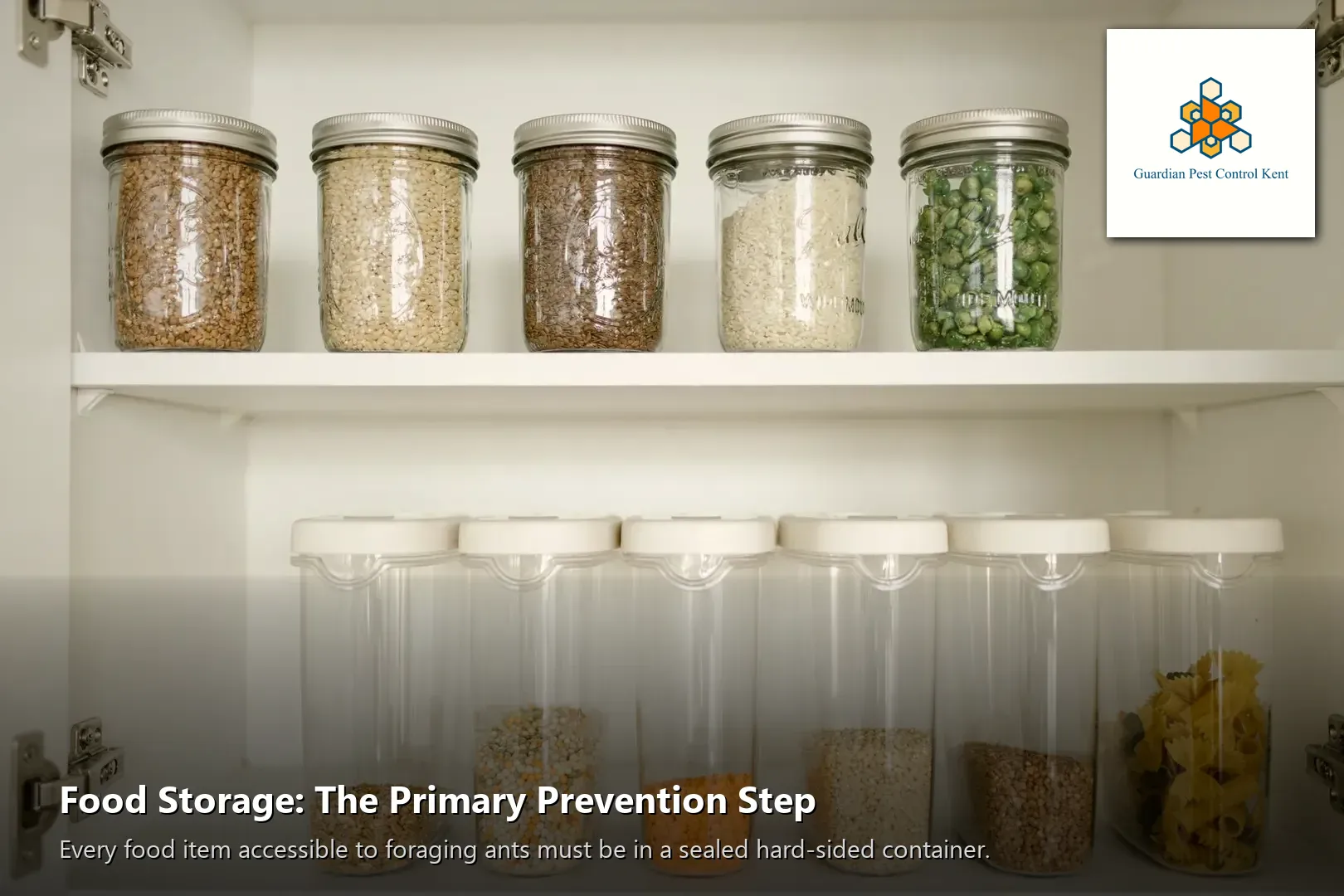
Items that require hard-sided sealed containers
| Food category | Why it attracts ants | Correct storage |
|---|---|---|
| Sugar, honey, maple syrup | Primary odorous house ant attractant - carbohydrate preference | Glass or hard plastic container with tight lid |
| Cereals, oats, granola | Sugar and grain content; cardboard is not a barrier | Airtight canister - not the original box |
| Flour, cornmeal, rice | Carbohydrate source; paper packaging has no barrier value | Sealed glass or plastic container |
| Fruit (bananas, apples) | Ripe fruit releases volatile compounds detectable at distance | Refrigerator or sealed bowl above the counter |
| Pet food | Protein and carbohydrate - highly attractive | Sealed pet food bin; never leave bowl out overnight |
| Cooking oil, butter | Lipid-phase attractant when colony is in protein/fat phase | Sealed containers; wipe exterior of bottles after use |
Sanitation: Daily Habits That Block Scout Signals
Food signals that attract ant scouts are often invisible. The residue from a sugary coffee spill wiped with a dry cloth leaves a sugar film on the surface that odorous house ant scouts detect reliably. Effective kitchen sanitation for ant prevention requires:
- Wipe countertops with a diluted detergent solution every evening - detergent dissolves sugar films and disrupts pheromone trails simultaneously. Plain water does not remove either.
- Clean the stovetop after every cooking session - food splatter and grease accumulation on burner rings and the stovetop surface are a major ant attractant in Kent kitchens.
- Clean the inside of the microwave weekly - food residue inside the microwave is not visible from outside but provides a strong food signal through the ventilation gaps.
- Empty the kitchen bin every 24–48 hours - a bin with any food residue provides a permanent food signal regardless of other prevention measures. Keep a bin with a tight-fitting lid; never use an open-top bin.
- Clean under and behind appliances quarterly - the space under the refrigerator, dishwasher, and oven accumulates food debris that provides a persistent food signal inaccessible to regular cleaning.
- Rinse dishes immediately - leaving food-residue dishes in the sink overnight is the single most common cause of kitchen ant trails in Kent homes with otherwise good sanitation practices.
Moisture Control: Eliminating the Year-Round Attractant
A kitchen with a persistent moisture source - a slow drip under the sink, a degraded dishwasher door seal, or a refrigerator water line fitting that drips once an hour - provides an ant colony with a year-round water source independent of food availability. Even if all food signals are removed, the colony continues foraging to the moisture source and explores adjacent surfaces for food on each visit.
Moisture points to check and repair
- Under-sink plumbing - inspect the P-trap, supply lines, and all fittings for any drip or condensation. Replace deteriorated supply line braiding before a slow drip develops.
- Dishwasher drain connection - the drain hose connection at the sink drain and the inlet connection at the dishwasher are common slow drip points. Check both connections with a tissue after a full wash cycle.
- Refrigerator drain pan - refrigerator defrost water collects in a drain pan below the appliance. A leaking drain pan creates a persistent moisture source under the refrigerator that is invisible without moving the appliance.
- Sink perimeter caulk - failed caulk around the sink basin allows water to seep under the countertop and into the cabinet below, creating persistent moisture in an enclosed space ideal for ant nesting.
Entry Point Sealing: Closing the Routes Into the Kitchen
Ants travel from outside the foundation into the kitchen through specific structural routes. Sealing these routes is the only prevention measure that remains effective when a food signal or moisture source is temporarily present.
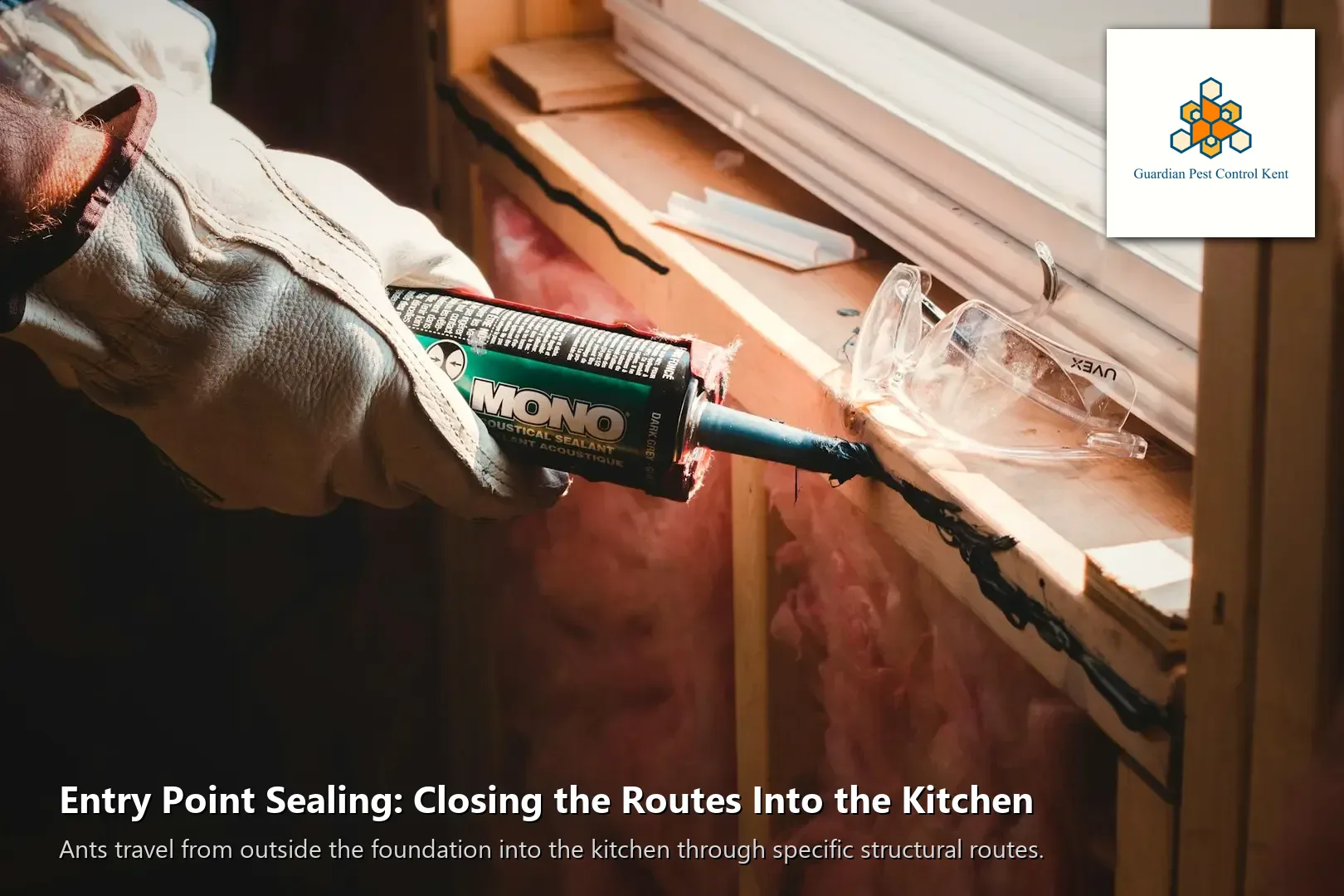
Primary entry points in Kent, WA kitchen areas
- Pipe gaps under the kitchen sink - the gap between the drain pipe and the cabinet base hole is the most common entry route. Apply silicone caulk around the cold supply, hot supply, and drain pipe where they pass through the cabinet base.
- The gap between the dishwasher and the cabinet - the power cord and drain hose pass through gaps in the cabinet that connect to the wall void. Seal with a fire-rated foam or silicone.
- Baseboard gaps in the kitchen - old or deteriorated baseboard caulk leaves a 1/16–1/8 inch gap at the floor line that connects to the wall void. Apply a bead of paintable caulk along all kitchen baseboards.
- The space around the refrigerator water line - the refrigerator water line passes through the wall behind the refrigerator. Seal around the line at the wall penetration point.
- Window frame gaps above the kitchen sink - windows installed over the kitchen sink often have degraded weatherstripping or a gap between the frame and the rough opening. Inspect from outside and seal with exterior-grade silicone.
Exterior Prevention: Stop Colonies Before They Reach the Wall
- Remove mulch from the 12-inch foundation zone outside the kitchen - wood chip mulch retains moisture and provides nesting material. WSU Extension identifies this as the primary ant harborage factor in western Washington residential settings.
- Trim plants away from the kitchen siding - plant stems in contact with the exterior siding provide an ant bridge over any treated perimeter surface.
- Store firewood and lumber away from the foundation - carpenter and odorous house ants nest in stacked wood piles. A wood pile against the kitchen exterior wall places an established colony 6 inches from the primary entry route.
When Prevention Has Failed: Signs of an Established Interior Colony
Call a WSDA-licensed pest control company when any of these conditions are present:
- Ants trail continuously inside the kitchen for more than two weeks despite removing food sources
- Ants emerge from wall outlets, from the gap under the baseboard, or from behind the dishwasher - indicating an interior nest, not a foraging incursion
- Ant activity resumes within 3–5 days of wiping down all trails
- Ants are present in winter months - in Kent, WA, winter kitchen ants are always interior-nesting, not outdoor foragers
An established interior satellite colony requires professional gel bait treatment. At this stage, prevention measures alone will not resolve the infestation - the colony must be eliminated at the source before prevention measures can be effective.
Frequently Asked Questions
Why do ants keep coming back to my Kent, WA kitchen?
Ants return because the pheromone trail laid by scout workers persists on the surface after the workers are removed. Wiping a trail with water does not fully destroy pheromones. Additionally, if the food source or moisture attracting the colony is not eliminated, new scouts will find it and lay a new trail within days. Persistent reinfestation indicates an unresolved food signal, a moisture source, or an unsealed entry point.
What smell keeps ants out of the kitchen?
No household scent reliably repels odorous house ants over a period longer than a few hours. Cinnamon, peppermint oil, vinegar, and chalk are frequently cited as repellents, but no peer-reviewed research supports these as reliable barriers against the species common in Kent, WA kitchens. Physical exclusion and eliminating food signals are the only methods with documented, durable effectiveness.
Are ants in the kitchen dangerous to health in Washington State?
Odorous house ants are not known to transmit disease directly. However, they forage in drain areas, garbage, and soil before crossing food preparation surfaces, creating a contamination pathway. The USDA identifies ants as a food safety concern in food handling environments. In residential kitchens, the primary risk is contamination of food preparation surfaces and open food products.
Do I need a pest control company for ants in my kitchen or can I do it myself?
Ant prevention - sanitation, food storage, and entry point sealing - can be completed without professional help and is effective when the colony is not yet established inside the home. Once ants are trailing continuously inside the kitchen for more than two weeks, the colony has likely established a satellite nest inside the wall structure. At this stage, professional gel bait treatment is required - DIY sprays trigger colony splitting in multi-queen species.
How do I stop ants from getting into my dishwasher in Kent, WA?
Seal the gap around the drain line where it passes through the cabinet base with silicone caulk. Clean the dishwasher filter and door gasket monthly - food particle accumulation in the filter and residue on the door seal attract odorous house ants to the dishwasher interior.
Should I use ant bait or ant spray in my kitchen?
Use slow-acting gel bait in the kitchen - never repellent spray. Gel bait placed along foraging trails is carried back to the colony by workers and kills the queen. Repellent spray kills foraging workers without affecting the colony, triggers budding in odorous house ants, and leaves a pesticide residue on food preparation surfaces.
Why are there ants in my kitchen in winter in Kent, WA?
Odorous house ants remain fully active year-round in western Washington because indoor temperatures stay above their activity threshold of 50°F. A colony that established a satellite nest inside the wall cavity adjacent to the kitchen in spring will forage continuously through winter. Winter kitchen ants in Kent, WA indicate an interior nest - not outdoor foragers - and require professional bait treatment to eliminate.
Summary
Preventing ants in a Kent, WA kitchen requires consistent removal of all three ant attractants: food signals, moisture, and entry points. Store all food in sealed hard-sided containers, clean surfaces daily with detergent, repair any moisture source under the sink or dishwasher, and seal pipe gaps with silicone caulk. Address exterior mulch and landscaping to prevent colonies from establishing adjacent to the kitchen wall. If ants are already trailing indoors despite these measures, professional gel bait treatment is required.
Guardian Pest Control provides WSDA-licensed ant control services in Kent, WA including species identification, targeted bait treatment, and entry point assessment. The quarterly residential programme maintains a continuous perimeter barrier that supports every kitchen prevention measure. Call (304) 684-6328 Monday–Saturday or book a free estimate online.
Sources
- WSU Extension - Ants in and Around the Home: extension.wsu.edu
- USDA Food Safety - Pest Control in Food Environments: usda.gov
- EPA - Pesticide Safety in the Kitchen: epa.gov/safepestcontrol