
Key Takeaways
- Norway rat droppings measure 3/4 inch with blunt ends - 40+ in one area indicates an established colony.
- Gnaw marks with ridged tooth patterns confirm rat activity; smooth gnaw marks indicate mice.
- Grease rub marks along walls form where rats travel the same route repeatedly - a clear sign of an established run.
- Daytime scratching sounds in walls suggest a large, overcrowded colony.
- Burrow holes 2–4 inches wide near foundations, decking, or compost bins are a Norway rat signature.
- A single rat seen indoors typically means a colony of 10–25 is present.
- Rat populations can double every 21 days - early treatment is always lower cost than delayed treatment.
Sign 1 - Rat Droppings Near Food, Walls, or Nesting Areas
1Rat droppings are the most definitive evidence of an active infestation. Norway rat droppings measure 3/4 inch (19 mm) long, are dark brown to black, and have blunt ends. Roof rat droppings are smaller - 1/2 inch (12 mm) - with pointed ends. Fresh droppings are soft and glisten; droppings older than three days harden and fade to grey.
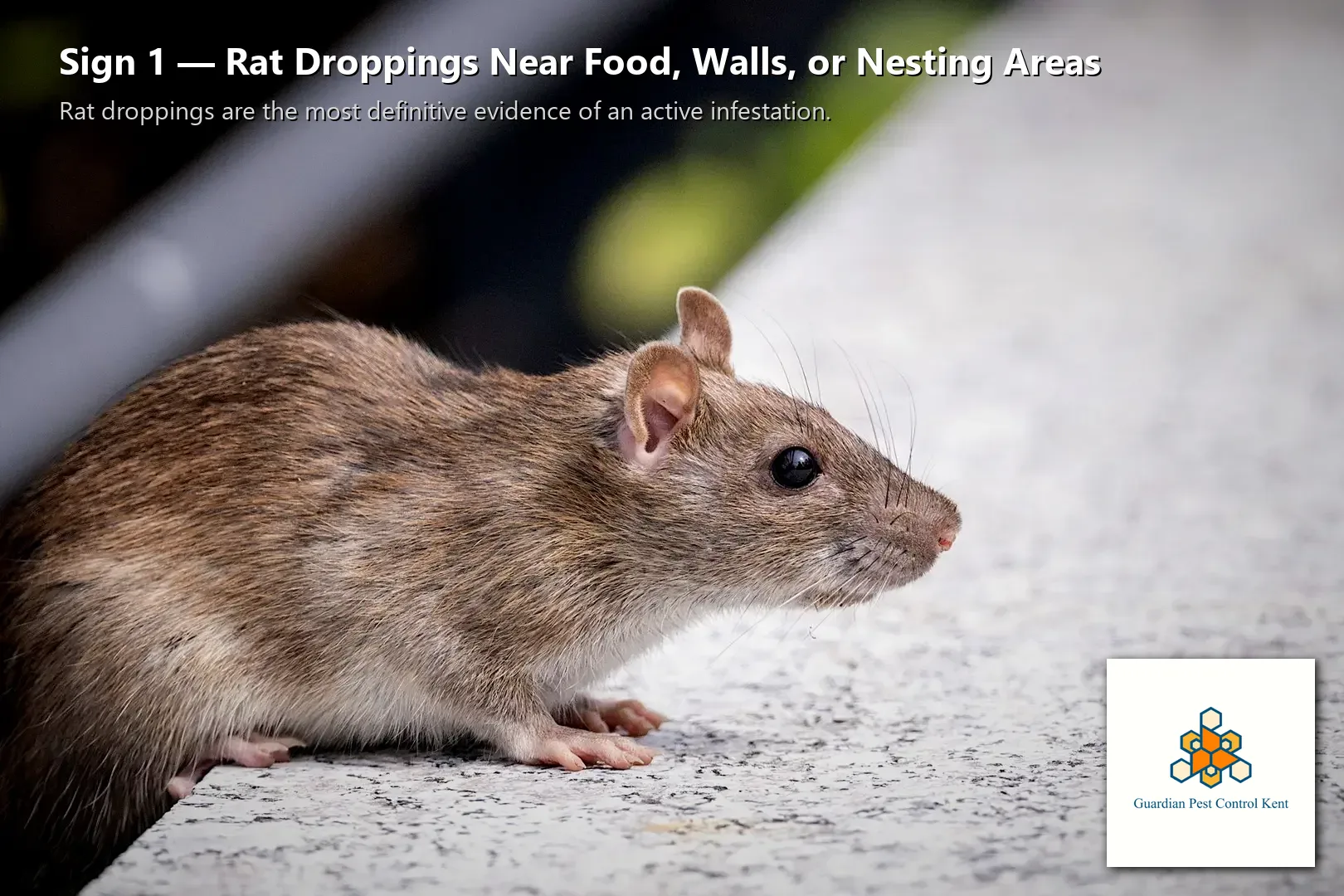
Location matters as much as the droppings themselves. Droppings concentrated along walls, behind appliances, inside cupboards, or near food storage areas indicate active feeding zones. Finding 40 or more droppings in a confined area confirms an established colony, not a solitary transient animal. High dropping counts in ceiling spaces or wall voids indicate rats nesting inside the building structure rather than simply passing through.
Norway rat vs roof rat droppings - comparison
| Feature | Norway Rat | Roof Rat |
|---|---|---|
| Length | 3/4 inch (19 mm) | 1/2 inch (12 mm) |
| Shape | Capsule, blunt ends | Spindle, pointed ends |
| Location | Ground level, behind appliances | Attic, rafters, upper walls |
| Common in Kent WA | Primary species | Secondary species |
Sign 2 - Gnaw Marks on Wood, Wiring, and Food Packaging
2Rats gnaw continuously because their incisor teeth grow at 4–5 inches per year and must be worn down. Gnaw marks appear on structural wood (joists, studs, door frames), electrical wiring insulation, plastic plumbing pipes, and cardboard food packaging. The NPMA identifies electrical wire damage from rodent gnawing as a contributing factor in 20–25% of unexplained house fires in the United States.

Rat gnaw marks display two parallel ridges from incisor teeth and measure approximately 1/8 inch wide. Fresh gnaw marks are light-coloured; older marks darken with age. Smooth, single-toothed gnaw marks indicate mice rather than rats. Finding gnaw marks on live electrical wiring requires immediate action - chewed wiring creates fire risk independent of the infestation itself.
In Kent homes built before 1990, rats frequently gnaw through the original ABS or copper plumbing connections in crawl spaces, causing slow leaks that feed the moisture conditions attracting further pests. For properties along the Soos Creek corridor, where crawl space moisture is elevated, this combination is particularly common.
Sign 3 - Grease Rub Marks Along Walls and Baseboards
3Rats navigate by touch, following the same routes repeatedly with their bodies pressed against walls. This behaviour deposits a dark, greasy smear from body oils and dirt accumulated in their fur. Rub marks appear as dark smudges along baseboards, at floor level near wall edges, and on the sides of entry points such as gaps around pipes or joists.
Fresh rub marks are soft and greasy to the touch. Older marks are hard and encrusted. Multiple dark marks along a single wall section confirm an established run - a route used by the same colony daily. Rub marks around a hole 2 inches or larger in a wall, floor, or ceiling indicate a primary entry or exit point used by the colony. Sealing these points is a core component of exclusion treatment.
Sign 4 - Scratching, Scurrying, or Gnawing Sounds at Night
4Norway rats are nocturnal and peak in activity between midnight and 4 a.m. Sounds heard inside walls, under floors, or in the ceiling space during these hours are a reliable indicator of an active rat presence. Common sounds include: scratching (nails on wood or drywall), scurrying (rapid movement between wall voids), gnawing (rhythmic chewing on hard surfaces), and squeaking (social vocalisations within the colony).
The location of sounds identifies where rats are nesting and travelling. Sounds in the attic or upper ceiling indicate roof rats or Norway rats nesting above the insulation. Sounds under floors or in crawl spaces indicate Norway rats nesting in the substructure. Sounds inside the wall cavity between the kitchen and a neighbouring room indicate a travel corridor connecting the outdoor entry point to an interior food source.
Daytime sounds are a more serious indicator than nocturnal sounds. Rats that forage during daylight hours are typically members of an overcrowded colony where competition for food forces some individuals outside their normal activity window. Daytime rat sightings or sounds in a Kent home indicate a large, established population requiring immediate professional treatment.
Sign 5 - Shredded Nesting Materials in Hidden Spaces
5Rats build nests from any soft, fibrous material available - shredded paper, insulation, fabric, cardboard, and plant matter. Nests appear as compact, dense balls of shredded material 6–12 inches in diameter. Common nesting locations in Kent homes include: behind wall insulation in crawl spaces, inside kitchen cabinet bases, beneath appliances with floor-level heat output (dishwashers, dryers), inside stored boxes in garages, and in the corner voids of attic spaces.
A nest containing pups (young rats without fur) or a nursing female confirms active breeding. Breeding pairs produce 4–6 litters per year with 7–12 offspring per litter. WSU Extension documents that Norway rats in the western Washington lowlands breed year-round due to mild winter temperatures, unlike inland populations that experience seasonal breeding suppression.
Sign 6 - Gnawed or Contaminated Food and Packaging
6Rats consume 1 ounce of food per day and contaminate 10 times that amount through droppings, urine, and fur. Signs of rat feeding activity include: chewed holes in bags of rice, flour, or pet food; gnawed corners on cardboard boxes; partially eaten fruit or vegetables; and smeared droppings or urine staining inside food storage areas. Rats prefer high-carbohydrate foods - cereals, grains, and fruits - but consume meat, pet food, and compost when alternatives are unavailable.
Food contaminated by rats poses a direct public health risk. The CDC identifies salmonellosis as transmissible through rat urine and faeces on food contact surfaces. Any food with evidence of rat contact must be discarded. All food in an infested area should be transferred to hard-sided, rat-proof containers - rats gnaw through cardboard and thin plastic within minutes.
Sign 7 - Burrow Holes Near the Foundation, Decking, or Compost
7Norway rats are burrowing animals that excavate tunnel systems 12–18 inches deep under foundations, concrete slabs, decking, and wood piles. Burrow entrances measure 2–4 inches in diameter, are circular, and have smooth, compressed edges from repeated use. Fresh burrows have a fan-shaped dirt scatter at the entrance. Abandoned burrows accumulate debris and cobwebs at the entrance opening.
Burrows directly under the foundation of a Kent home create voids that allow cold air, moisture, and further pest entry. Multiple burrows in a cluster indicate a colony rather than a single animal. Norway rat burrows connected to the exterior of the home require both colony elimination and structural exclusion - removing the colony without sealing the burrows allows reinfestation from neighbouring areas within weeks.
Check the following exterior locations during a self-inspection: the gap between the concrete foundation and wood sill plate, soil along fence lines adjacent to compost or waste bins, under wood decking, around conduit or pipe penetrations through foundation walls, and in ornamental rock beds against the house perimeter.
What to Do After Finding Evidence of Rats
Finding any of these seven signs warrants a professional inspection. Rat populations double every 21–28 days. A colony of five rats becomes 160 within eight weeks when left untreated. The cost of professional treatment scales directly with colony size - early treatment is always less expensive than delayed treatment.

A WSDA-licensed pest control specialist will conduct a full inspection covering:
- Interior and exterior evidence mapping (droppings, gnaw marks, rub marks)
- Entry point identification - every gap wider than 1/2 inch
- Colony size estimation from evidence density
- Treatment recommendation: snap traps, rodenticide bait stations, or exclusion-first protocol
- Follow-up schedule for monitoring and sealing after population has collapsed
Frequently Asked Questions
What do rat droppings look like in a Kent WA home?
Norway rat droppings measure 3/4 inch long, are dark brown to black, and have blunt ends. Roof rat droppings are smaller at 1/2 inch with pointed ends. Fresh droppings are soft and dark; droppings older than three days become hard and pale. Finding 40–50 droppings in a confined area indicates a well-established infestation.
Can rats enter a Kent home through the drains or sewers?
Yes. Norway rats swim and can enter homes through floor drains, broken sewer lines, and toilet bowl traps when sewer pressure drops. This entry point is most common in older Kent homes built before 1980 with clay or cast-iron sewer lines. A WSDA-licensed exclusion specialist can identify and seal these access routes.
How quickly does a rat infestation grow in Washington State?
A single breeding pair of Norway rats produces 4–6 litters per year, with 7–12 offspring per litter. Under optimal conditions, two rats can become more than 1,000 within 12 months. Washington State’s mild winters in the Puget Sound lowlands allow year-round breeding, making early detection and fast response critical.
Are rat sounds louder at night?
Yes. Norway rats are predominantly nocturnal, peaking in activity between midnight and 4 a.m. Sounds heard during the day - scratching, gnawing, or squeaking inside walls - indicate a large, established colony where competition for resources forces some individuals to forage during daylight hours.
How many rats are in my home if I see one?
Seeing one rat indoors typically means a colony of 10–25 is present. Norway rats are cautious and rarely venture into open spaces until their population has outgrown their nesting area. One live sighting during daylight hours is a strong indicator of an overcrowded, established colony.
What diseases can rats spread in Kent, WA?
According to the CDC, rats directly transmit more than 11 diseases to humans, including leptospirosis, hantavirus pulmonary syndrome, rat-bite fever, and salmonellosis. Rats also carry fleas that transmit murine typhus. In King County, hantavirus exposure risk is documented in rural and semi-rural areas of South King County.
When should I call an exterminator for rats in Kent WA?
Call a WSDA-licensed pest control company immediately upon finding any confirmed evidence: droppings, gnaw marks, live or dead rats, or burrows. Rat populations double every 21–28 days. Delaying treatment by even two weeks allows a colony to expand significantly, increasing treatment cost and structural damage.
Summary
The seven warning signs of a rat infestation - droppings, gnaw marks, rub marks, sounds, nesting materials, food damage, and burrows - each identify a specific aspect of the colony’s behaviour and location. Finding even one sign warrants an immediate professional inspection.
Guardian Pest Control provides WSDA-licensed rodent control services across Kent, WA and South King County. The rat control service includes a full inspection, evidence mapping, colony treatment, and a sealed exclusion plan. Call (304) 684-6328 Monday–Saturday, 8 a.m. to 6 p.m., or book a free estimate online. Same-day response is available for confirmed active infestations.
Sources
- CDC - Rodents: cdc.gov/rodents
- NPMA - Rodent Pest Guide: npmapestworld.org
- WSU Extension - Rats and Mice: extension.wsu.edu
- King County Public Health - Rodent Control: kingcounty.gov